Table of Contents
Uber and Lyft disrupted taxis so completely that most Americans never considered an alternative. Well, these days, that is changing. On platforms like Reddit, Hacker News, and X, Americans are venting their frustrations about the not-so-cool experiences they’ve had using these ride-hailing services, and many say they are switching to Waymo, the self-driving company owned by Alphabet.
Between 2021 and 2022, Uber reported 2,717 sexual assault incidents. Lyft reported 2,651 across its 2020–2022 period. A New York Times investigation published in August 2025 found that Uber received a report of sexual assault or misconduct in the United States almost every eight minutes on average between 2017 and 2022, substantially more than what the company had publicly disclosed. Lyft agreed to a $25 million shareholder settlement in July 2025 related to its disclosures about assault incidents.
A separate December 2025 New York Times investigation revealed that in 22 states, Uber drivers with histories of child abuse, assault, and stalking could continue working as long as their convictions were more than seven years old. Uber announced a revised background check policy in February 2026 in response.
Frustrations are growing every day. Hacker News user socalgal2 described regularly recording drivers “going 15–20 miles over the speed limit,” and said the scariest ride they’d taken involved a driver checking their stock portfolio on their phone mid-trip.
User MBCook complained: “With Uber/Lyft you don’t know. Many drivers do a great job and treat their cars and passengers like professionals. Others don’t.” The variable is the human, and the human is unverifiable until you’re already in the car.
Then there’s tipping culture. Both platforms frame it as optional. However, many riders feel pressured by the rating system. Hacker News user StableAlkyne said: “I’m hoping Waymo takes Uber’s lunch money. I will gladly pay more for a service that has not been infected with tipping.”
What the Waymo Ridehailing Experience Actually Feels Like
Every Waymo vehicle is the same make and model. Every ride follows the same smooth, law-abiding driving style. You won’t get a driver running red lights or someone who treats your trip as secondary to their personal phone call.
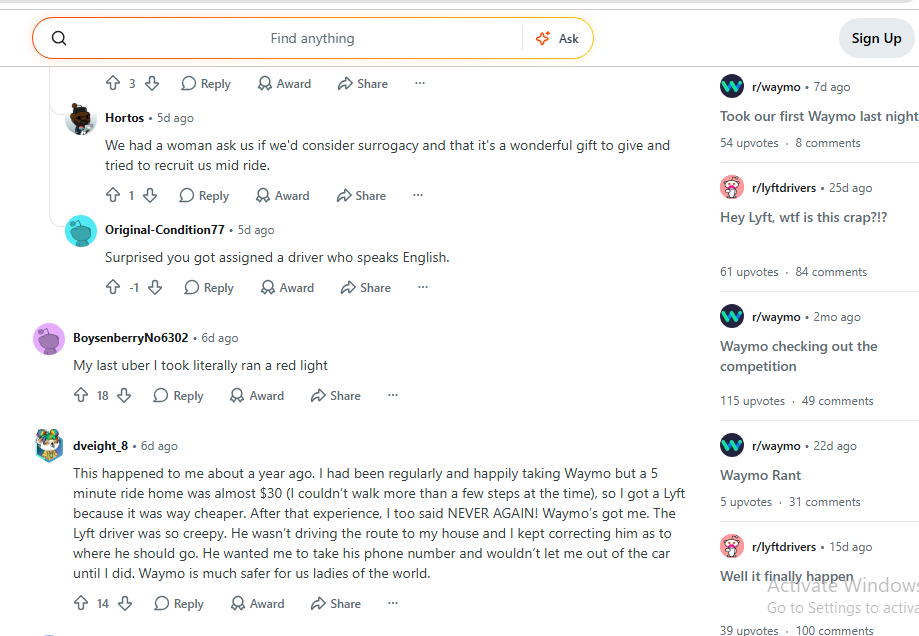
Users in this Waymo subreddit vent their frustrations about Uber and Lyft:
A Hacker News user said:
“When you ride in an Uber or a taxi, you’re a guest in the driver’s space. In a Waymo, it’s your own space. You can play music, talk on the phone, without worrying about disturbing the driver. You’re not likely to have strong odors, or driver’s phone conversations. And the experience will be roughly consistent each time. In an Uber, you have no idea what the car or the driving standards will be like until you’re in it.”
Another user said: “I will pay a premium for not having to deal with a human being in the car with me. It’s a dice roll: you could get a very extroverted driver who won’t leave you alone, or someone who smells bad, or someone rude, or a distracted driver. Just let me sit in peace, alone with a robot.”
A predictable, professional service is what riders are paying for. Human-driven rideshare hasn’t reliably delivered it.
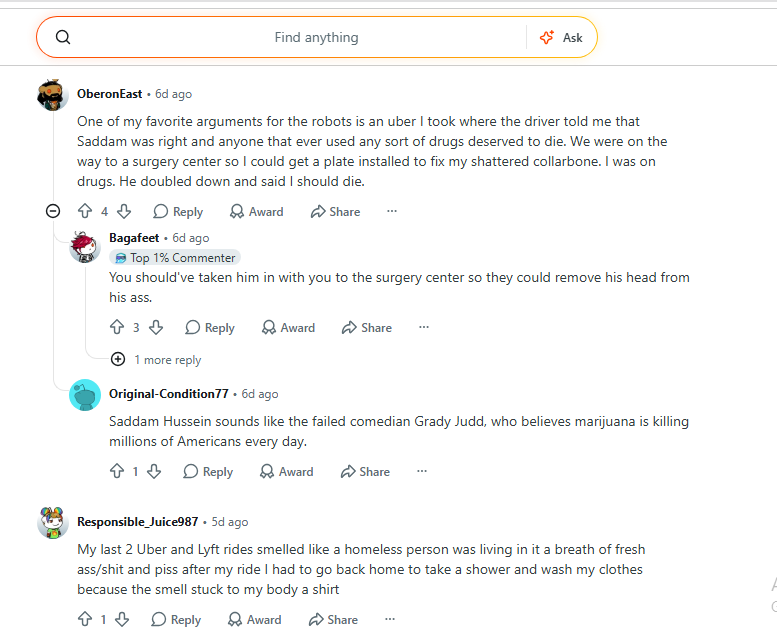
More complaints on Reddit:
The Women’s Safety Factor
A USA Today columnist who wrote about Waymo in April 2026 said something that many female riders have felt quietly for a while: “I never thought I’d feel comfortable in an autonomous car. Yet, perhaps ironically, I’m less concerned about my safety as a human woman in a driverless car than I am in one with a person behind the wheel.” She described herself as someone skeptical of AI in everyday life, which makes her preference more striking.
Women traveling alone have always done a mental calculation before getting into a car with a stranger. Waymo removes that variable entirely. I’ll be honest: when you’ve spent years running that quiet risk assessment every time you book a late-night ride, then self-driving robotaxis are absolutely worth it.
The Safety Data
The Waymo ride-hailing safety record has drawn serious attention from medical researchers and public health professionals. Across 170.7 million fully autonomous miles driven in Phoenix, San Francisco, Los Angeles, and Austin, Waymo vehicles were involved in 92% fewer crashes resulting in serious injury or worse compared to human drivers covering the same routes. Airbag-deployment crashes were down 83%. Any-injury crashes dropped 82%.
Pedestrians and cyclists saw comparable reductions: 92% fewer pedestrian injury crashes and 85% fewer cyclist injury crashes. Waymo recorded 0.02 serious-injury-or-worse incidents per million miles, against 0.22 for human drivers on the same roads.
Dr. Jonathan Slotkin, a neurosurgeon who spent weeks analyzing Waymo’s publicly released safety data, argued in the New York Times that these vehicles represent a genuine public health breakthrough. He noted that over 39,000 Americans died in motor vehicle crashes in a single year.
The peer-reviewed research supports this. A study published in Traffic Injury Prevention found Waymo’s injury-reported crash rate was 0.41 incidents per million miles, versus 2.80 for human drivers on comparable roads. A follow-up study covering 56.7 million miles confirmed statistically significant reductions across 11 crash types. David Zuby, chief research officer at the Insurance Institute for Highway Safety, described the underlying methodology as “a good-faith effort” with results he called encouraging.
These figures come from NHTSA-mandated crash reporting data cross-referenced against state police records in Waymo’s operating cities.
From Startup to Market Leader
Waymo began commercial rides in May 2023, doing roughly 10,000 trips per week. By late 2025, that number had reached 450,000 weekly rides across six U.S. cities, a 157% year-over-year increase.
According to YipitData analysis, Waymo went from zero market share to surpassing Lyft in just 20 months. By April 2025, Waymo held roughly 27% of rides within its operating zone. Lyft’s share dropped from 34% to around 21% over the same period. Uber fell from 66% to approximately 55%.
Waymo achieved this with roughly 1,000 vehicles in a geofenced zone that originally excluded airports and freeways. Airport service has since expanded to Phoenix Sky Harbor, San José Mineta International, and San Francisco International. The company completed 20 million lifetime rides by end of 2025. In February 2026, Waymo Co-CEO Tekedra Mawakana said the company is on track to surpass 1 million weekly rides by end of 2026. Expansion plans include more than 20 new cities in 2026, including Tokyo and London.
The company closed a $16 billion funding round in February 2026 at a $126 billion valuation.
Why People Are Paying the Premium
Waymo fares run about 31% higher than Uber and 41% higher than Lyft within comparable zones. Riders are paying it anyway.
Hacker News user fluidcruft noted: “I haven’t been in a Waymo but I generally tip well in Uber or Lyft. I wouldn’t tip a robot. So at least to me, $15 plus a $5 tip versus $20 is pretty much a wash.”
Beyond the numbers, there’s the question of what people are paying for.
User test6554 said, “You’re not paying more for the same ride. You are paying to have some time alone. To not have to deal with others where you can listen to an audiobook, have a conversation on your phone that feels private, or other things.”
For women, for parents, for anyone who’s had a genuinely frightening Uber, the Waymo ride-hailing experience offers something no rating system or background check update can replicate: a ride where the driver is gone completely.
The Data Enigma
Waymo vehicles record the interior of the car during each ride. This is disclosed in the app and is standard practice for driverless fleet vehicles. California residents can request deletion of their personal data, including ride history, and Waymo provides a process for this under the CCPA.
The bigger question is what happens to that data at scale under Alphabet’s ownership. Waymo vehicles generate substantial behavioral and location data with every trip. Riders accept this as part of the deal. Whether it remains a reasonable trade-off depends on how the company handles that data as its fleet grows into the tens of thousands.
A Permanent Shift
Waymo’s ride-hailing experience isn’t flawless. Their vehicles have struggled in scenarios requiring quick judgment, a known limitation the company says it’s addressing by making the system more confident in dense urban environments.
The truth, however, is that these nifty robocars have come to stay. For a growing number of Americans, the Uber and Lyft apps are still on their phones. They’re just not opening them as much anymore. And when they do, most try to match with a robotaxi.
You May Also Like:
Autonomous Vehicles: 10 Amazing Things to Know About Waymo
Waymo Airport Service Areas in the U.S. — A Complete Breakdown
Autonomous Vehicle Technology: Are We Convinced Enough?

I’m Dr. Brandial Bright, also known as the AVangelist. As a dedicated and passionate researcher in autonomous and electric vehicles (AVs and EVs), my mission is to educate and raise awareness within the automotive industry. As the Founder and Managing Partner of Fifth Level Consulting, I promote the adoption and innovation of advanced vehicle technologies through speaking engagements, consulting, and research as we progress to level 5 fully autonomous vehicles.