Table of Contents
On September 3, 2026, Zoox robotaxi began carrying paying passengers to and from Harry Reid International Airport in Las Vegas. It is the first fully driverless ride-hailing service ever authorized to operate at a major US airport terminal in this way.
Airport access is one of the hardest and most valuable stops to earn in the entire ride-hailing business.
Airports generate steady, predictable demand. Travelers land and need a ride right away, often to a hotel, a convention, or a Strip show. That demand does not depend on weather, local events, or time of day the way city rides do. It is baked into every flight schedule.
Zoox now serves both terminals at Harry Reid. At Terminal 1, drop-offs happen at the departures and ticketing level, while pickups are on Level 0 below baggage claim. At Terminal 3, both pickup and drop-off happen around Level 0, outside baggage claim. Airport officials added signage to guide travelers to the right spot.
Getting to this point took real work. Zoox spent several months testing its vehicles and mapping the airport environment before public rides began, working closely with the Clark County Department of Aviation to meet the airport’s operational requirements.
Airports are difficult terrain for autonomous vehicles. Traffic is always crowded and changing quickly, with lanes at the pick-up areas filling up and clearing out constantly. Pedestrians are often distracted as they walk across lanes pushing strollers or carrying heavy luggage. To make matters more complicated, traffic officers frequently direct cars by hand and change traffic patterns on the spot.
A self-driving taxi has to understand all of these fast actions perfectly every single time, because making a mistake near busy terminal doors is dangerous. This leaves no room for error, and that’s why very few self-driving companies have been able to offer airport service.
James Chrisley, Clark County’s director of aviation, called the launch a first for the technology in an airport environment. He framed it as a chance to study how autonomous vehicles can work alongside the many other ways travelers already move through LAS.
A First-Mover Advantage Nobody Else Has Yet
Here is what makes this moment more noteworthy than a routine service expansion: Zoox is currently the only robotaxi operator with authorization to serve Harry Reid International Airport. Waymo, Tesla, and Uber‘s Aviari Services do not have that access yet, even though all three now hold state permits to run robotaxis in Clark County.
The Nevada Transportation Authority approved those three companies to operate as Autonomous Vehicle Network Companies on August 20, 2026. Tesla can deploy up to 5,000 vehicles in its first year. Waymo and Aviari were each approved for up to 1,000. Their approved service areas include the airport on paper. Each company still needs separate authorization from the Clark County Department of Aviation before it can actually pick up or drop off a passenger there.
Zoox is visibly expanding its Las Vegas footprint, as well as securing a potentially valuable first-mover advantage at one of the country’s most strategically useful robotaxi markets.
Beating Uber and Lyft to Baggage Claim
A Zoox robotaxi can now collect passengers closer to baggage claim than Uber or Lyft can.
Traditional rideshare pickups at Harry Reid require a walk from baggage claim to a designated pickup floor in a nearby parking garage. According to TechCrunch, that walk typically takes five to ten minutes, longer with bags in tow, kids underfoot, or a red-eye flight behind you.
Zoox skips that detour. Instead of walking all the way to a parking garage, passengers can meet their self-driving taxi right outside the baggage pickup area at both terminals. For someone getting off a long five-hour flight, saving ten minutes on their way out of the airport is a major benefit. Thoughtful details like this often determine which ride app an exhausted traveler decides to open first.
The Federal Approval That Made This Possible
None of this would exist without a regulatory breakthrough that arrived just weeks earlier. On July 30, 2026, the National Highway Traffic Safety Administration granted Zoox the first commercial exemption ever issued to a purpose-built robotaxi. The exemption released Zoox from eight federal motor vehicle safety standards written for vehicles with a human driver behind the wheel, covering items like windshield defrosters, mirrors, and foot-operated brakes.
Zoox vehicles have no steering wheel and no pedals, so those standards never applied to them in a meaningful way. The exemption lets Zoox deploy up to 2,500 commercial vehicles per year for two years, under what NHTSA called an enhanced, adaptable oversight structure.
Zoox started charging passengers for rides in Las Vegas on August 10, 2026. On September 3, the company expanded this paid service to the local airport, connecting its vehicles to the single most important destination in a city built around tourism.
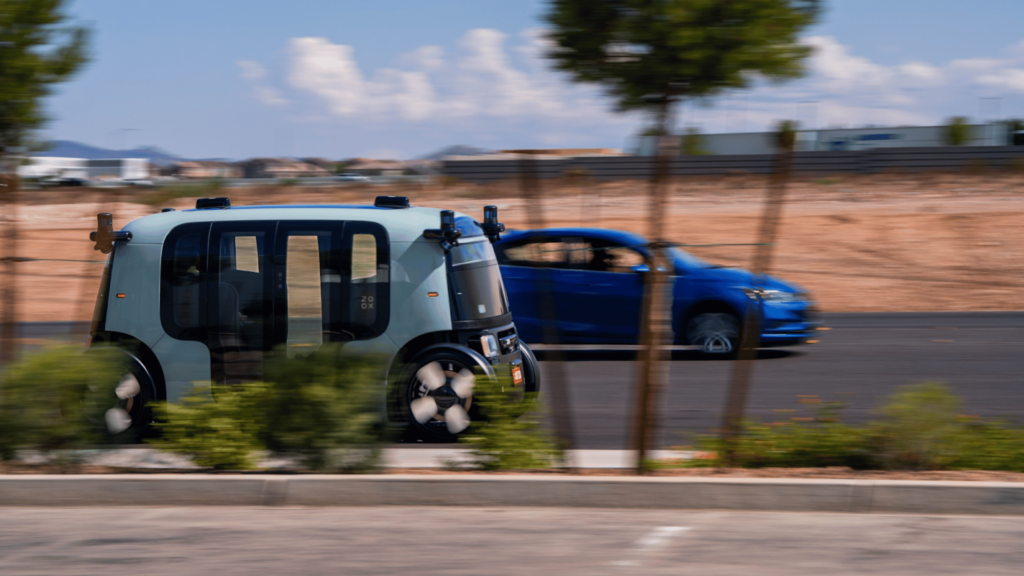
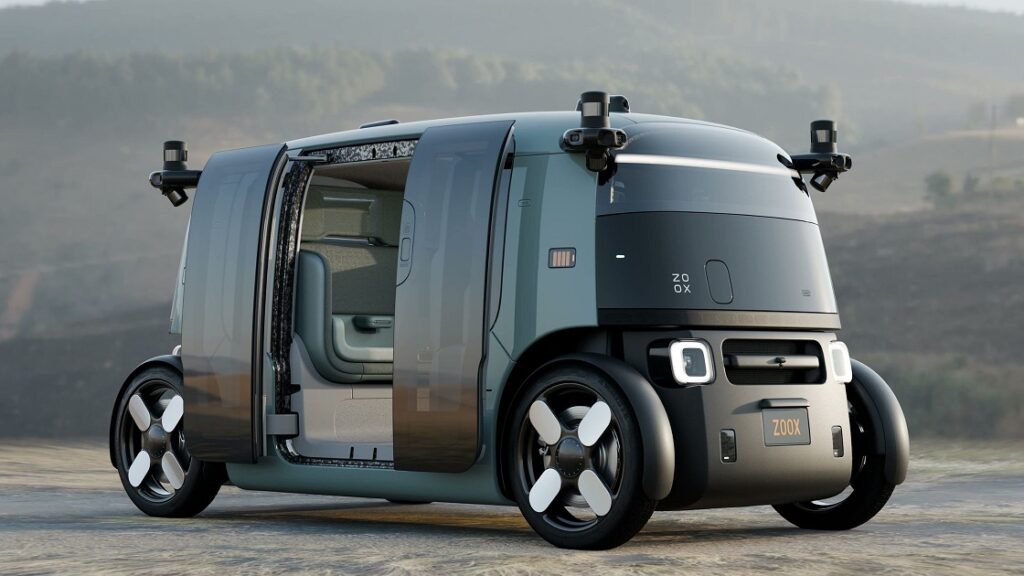
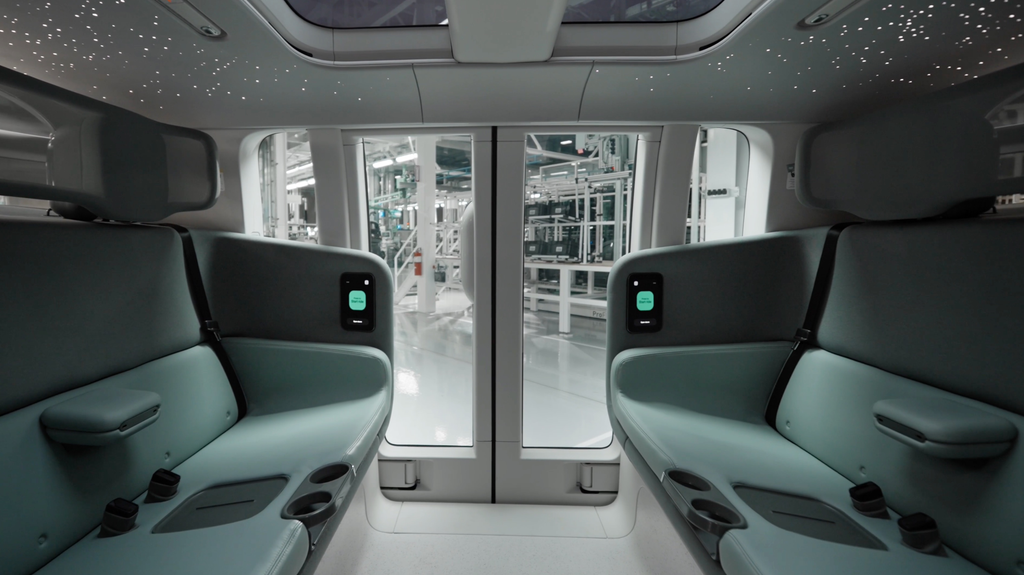
The Zoox robotaxi is designed from scratch rather than modified from a regular car. Zoox created its robotaxi as a small, four-passenger pod that can drive forward or backward without turning around. Inside, passengers sit in two rows facing each other, and the vehicle has no trunk or dashboard. Bags are kept on the floor, but they must remain low enough to leave the aisle clear. A feature called “Find My Zoox” uses flashing lights and sounds to help travelers locate their car in busy pickup zones, and riders can connect their phones via Bluetooth to play music.
Government regulators view these vehicles with caution. Zoox has reported past incidents to safety officials, including an empty robotaxi hitting a car in Las Vegas and another driving towards smoke near a fire before a remote operator backed it away. Following these events, Zoox paused operations, updated its software, and restarted under official government oversight. Zoox CEO Aicha Evans has called for stricter safety rules across the robotaxi industry, which is particularly important as the company expands into high-traffic areas like airports.
Las Vegas as America’s Robotaxi Proving Ground
Las Vegas has become the most closely watched market for self-driving cars in the United States. This growth is no accident, as the region features wide, well-mapped streets, a concentrated tourist area, and a local government that quickly created clear rules to welcome autonomous vehicles.
Several companies, including Tesla, Waymo, Aviari, and Zoox, now hold official state permits, with Zoox already offering paid rides to passengers. Within a year, thousands of robotaxis could be competing for customers in the area. However, securing a state permit is only the first step. Because casinos, major resorts, and the airport sit on private property, each self-driving company must negotiate separate pickup agreements with every individual location before it can operate there.
While Zoox’s early launch does not guarantee long-term leadership once competitors sign similar deals, it gives the company a key advantage. Zoox is currently collecting valuable real-world driving data on the popular route connecting the airport to the city, which almost every visitor uses.
Beyond the airport, Zoox focuses on high-demand locations, connecting passengers to roughly ten major resorts on the Strip—including Mandalay Bay, Luxor, MGM Grand, Aria, Bellagio, Wynn, Resorts World, and Fontainebleau—as well as popular entertainment spots like the Las Vegas Convention Center, AREA15, the Sphere, and T-Mobile Arena. However, major destinations like Caesars Palace, The Venetian, off-Strip hotels, and downtown Las Vegas are missing from the network. International tourists also face a hurdle, as the Zoox app is currently available only in the U.S. App Store.
Could Airport Routes Be the First Profitable Robotaxi Trips?
Self-driving taxi businesses have a hard time making money on short, cheap, and unpredictable city trips. Airport rides are different. The distances are longer and more predictable, and flight schedules ensure a steady stream of passengers. Plus, travelers carrying heavy bags often prefer a quick and easy pickup over finding the lowest possible price.
If any specific route can prove that self-driving taxis can make money, connecting an airport to a busy tourist area is the best place to start. Las Vegas might be the first city to prove whether this business model works, simply because it has more self-driving taxi companies than any other American city.
Zoox robotaxi currently has the lead. We await what comes next.
You May Also Like:
Zoox is 12! Says 2026 Is Its “Biggest Year Yet”
Is Zoox Robotaxi the Real Self-Driving Car?
AV Distribution War: Leading Self-Driving Companies Partnering With Uber and Lyft

I’m Dr. Brandial Bright, also known as the AVangelist. As a dedicated and passionate researcher in autonomous and electric vehicles (AVs and EVs), my mission is to educate and raise awareness within the automotive industry. As the Founder and Managing Partner of Fifth Level Consulting, I promote the adoption and innovation of advanced vehicle technologies through speaking engagements, consulting, and research as we progress to level 5 fully autonomous vehicles.