Table of Contents
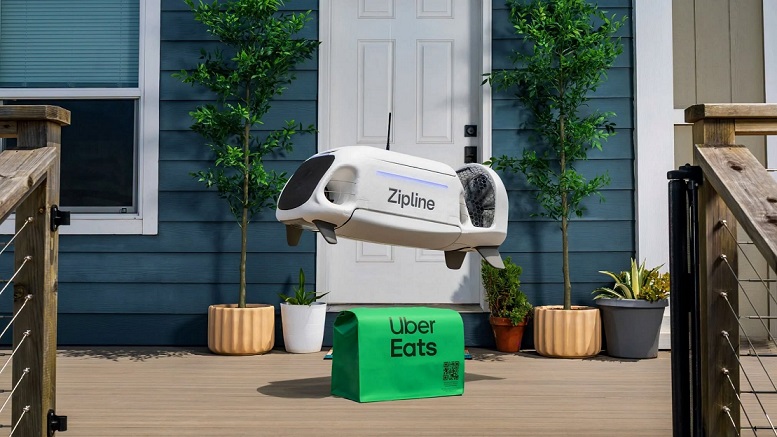
Uber and Zipline plan to complete one million Uber Eats drone deliveries every day by the end of 2029. The service will launch later this year in Dallas and Houston before expanding to dozens of other American cities. Uber is also investing directly in Zipline to help make this happen, though neither side has said how much.
Hitting one million deliveries a day in the U.S. alone by 2029 means growing delivery operations by more than 230 times in about three years. That’s literally rebuilding the company’s entire operating scale.
Uber CEO Dara Khosrowshahi told the Wall Street Journal that quick commerce now rivals the size of the original food-delivery market, and he expects it to be “an enormous tailwind for the next leg of growth for Eats.”
That means instead of just bringing restaurant meals to doorsteps in minutes, ultra-fast drone delivery could transform Uber Eats into a general shopping service for items like groceries, medicine, and electronics.
Why Uber Didn’t Build the Drone Itself
Uber used to build this kind of thing in-house. It ran Uber Elevate, an aerial ride-share program, and Uber Autonomous Technologies Group, its self-driving car unit. Both got sold off. In their place, Uber has spent more than $10 billion investing in outside autonomous vehicle companies and now counts more than 30 AV partners across its various businesses.
The Zipline deal follows that same pattern. Rather than spending years and billions engineering an aircraft, Uber gets to pair Zipline’s drones and flight software with what it already owns: tens of millions of Eats customers, relationships with hundreds of thousands of merchants, a routing engine, a payments system, and years of demand data telling it exactly where people order what and when. Zipline supplies the aircraft and the flying. Uber supplies the marketplace.
It honestly raises a question worth asking: In the future of autonomy, will the winners be the manufacturers of autonomous vehicles or will they be the ones that control the platforms that coordinate them?”
What Makes Zipline’s Hardware Different
Zipline uses a unique two-part system to deliver goods safely and quietly. A main drone stays high in the sky at about 300 feet, while a smaller tethered device lowers itself toward the ground to drop packages into a small, precise target area. These drones can carry up to eight pounds, handle round trips of about ten miles, and travel up to seven times faster than a delivery car.
Both companies are marketing Uber Eats drone delivery arriving in five to ten minutes. However, there are lingering questions to be answered.
Five to ten minutes from when, exactly? From the moment you tap order? From when the restaurant accepts it? From when the food is actually cooked and boxed? From drone launch, or from drone arrival over the delivery zone?
Zipline’s own language, in the companies’ announcement, describes delivering “anything people need in 5-10 mins,” which reads like flight time rather than the full order-to-doorstep clock a hungry customer actually experiences. A burrito still has to get made before it can fly anywhere, and kitchen prep time doesn’t disappear just because the last mile got faster.
None of that makes the number fake. It just means the honest answer to “how fast will my food actually arrive” depends on a restaurant’s kitchen speed as much as it depends on Zipline’s aircraft.
Zipline’s Track Record Is the Real Advantage
Zipline has completed more than 2.7 million deliveries carrying more than 20 million items, flown north of 135 million autonomous miles, and operates across four continents. It serves close to 5,000 hospitals and health facilities worldwide, a business model it offcially started in 2016, delivering blood and medical supplies in Rwanda.
On the commercial side in the U.S., Zipline already delivers for Walmart, Panera, Chipotle, Wendy’s, and Sweetgreen. It recently closed an extended Series H round of $800 million, pushing its valuation to $7.6 billion.
Drone Delivery Regulation in the US
The main delay for drone delivery in the United States has been government regulation. Current rules require a human to keep visual contact with the drone at all times, which limits how far it can go. However, new proposed rules would allow qualified companies to fly beyond the pilot’s line of sight without needing special permission for every trip. Zipline’s ability to launch deliveries through apps like Uber Eats largely depends on how quickly these rules are finalized.
Uber previously tested automous delivery using Waymo’s self-driving cars in select cities. Self-driving cars were able to launch faster because they did not need new air traffic laws, but they still get stuck in regular traffic. Once approved, drones can fly in a straight line over streets and buildings, making them much faster than cars over suburban distances.
The Competition Isn’t Waiting
Competition in the drone delivery industry is growing quickly. Uber and Zipline aren’t building this in an empty market. DoorDash received FAA Part 135 certification for its own in-house drone program, DoorDash Air, becoming the eighth U.S. company to hold it, and it already runs drone deliveries through a separate partnership with Alphabet’s Wing at shopping centers in Dallas-Fort Worth.
Alphabet’s Wing leads the market in total delivery volume. Its partnership with Walmart is set to reach more than 270 stores by the end of 2027, covering roughly 10 percent of the U.S. population, and the company says its heaviest users already order three times a week for small items like eggs, ground beef, and produce. Wing drones cruise around 150 feet, carry up to five pounds, and complete a delivery in as little as 15 minutes.
Amazon’s Prime Air, by contrast, has expanded rather slowly since launching in 2022. It is limited to a handful of markets in California, Texas, the U.K., and Italy, and has drawn criticism for how slowly it’s scaled.
Over time, drone technology may simply become a standard service that any platform can use, meaning the companies with the most existing customers will hold the real advantage.
You May Also Like:
AV Distribution War: Leading Self-Driving Companies Partnering With Uber and Lyft
Uber Autonomous Drone Delivery Takes Flight: Here’s What to Know

I’m Dr. Brandial Bright, also known as the AVangelist. As a dedicated and passionate researcher in autonomous and electric vehicles (AVs and EVs), my mission is to educate and raise awareness within the automotive industry. As the Founder and Managing Partner of Fifth Level Consulting, I promote the adoption and innovation of advanced vehicle technologies through speaking engagements, consulting, and research as we progress to level 5 fully autonomous vehicles.