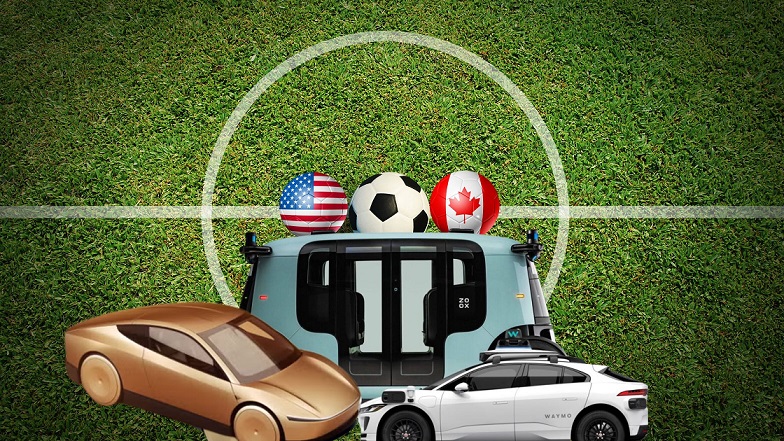
Sixteen cities across the US, Canada, and Mexico are hosting the FIFA World Cup 2026, but you can only book a Level 4 self-driving car in just six of them, and they are all in the United States. The tournament runs from June 11 to July 19, 2026, spread across stadiums in three countries.
Fans in Toronto or Mexico City still need a regular taxi or rideshare to reach the stadium. Fans in Atlanta, Dallas, Houston, Los Angeles, Miami, and the San Francisco Bay Area can hail a car with nobody behind the wheel.
The Robotaxi Race, in Numbers
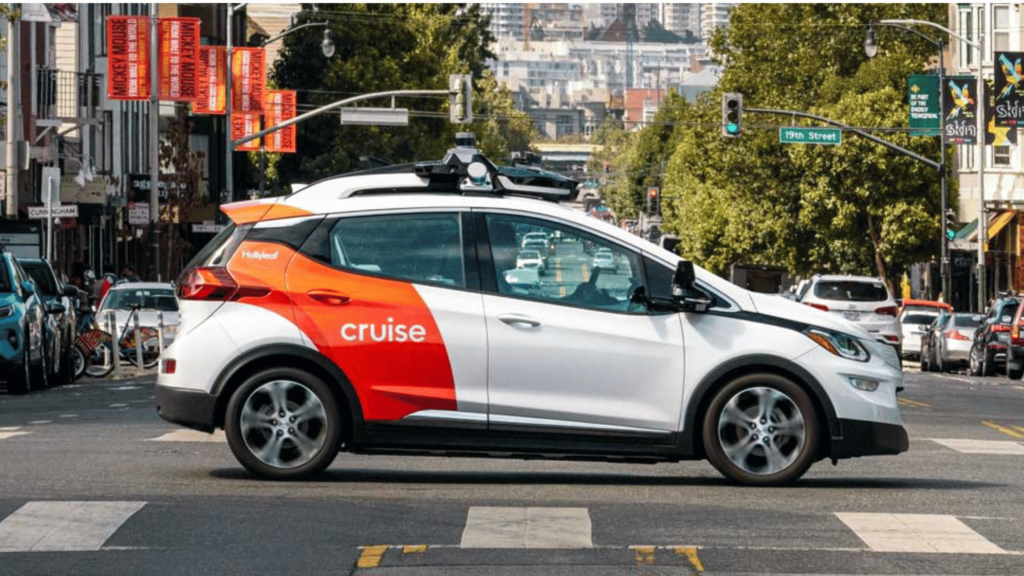
Waymo leads by a wide margin. The Alphabet-owned company has delivered more than 20 million paid trips since launch, runs a fleet of roughly 3,000 vehicles, and raised $16 billion this year at a $126 billion valuation to fund its expansion. It’s targeting 1 million rides a week by the end of 2026, up from around 500,000 today.
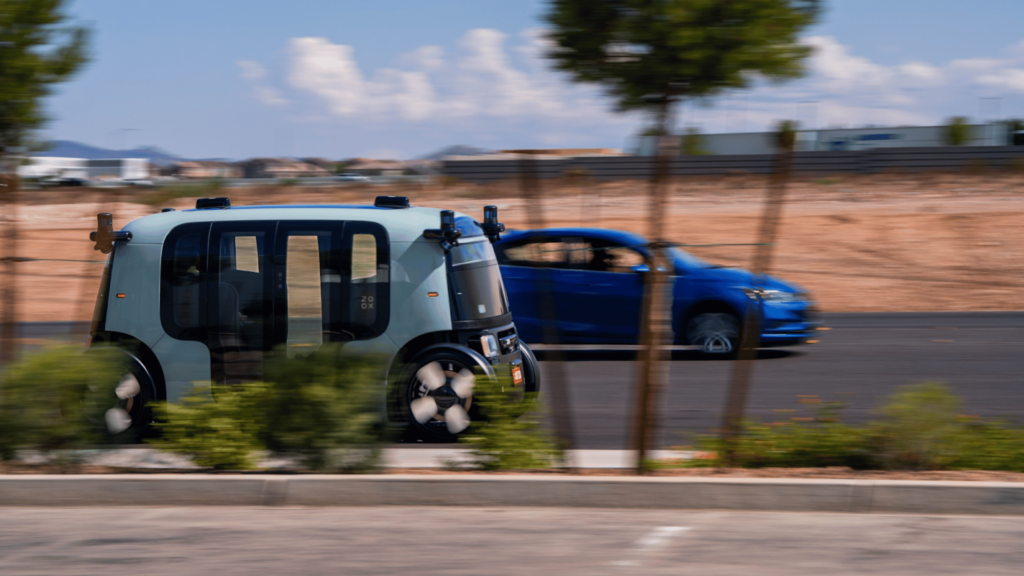
Tesla is newer to driverless rides and much smaller in scale, but it moved fast in 2026, skipping the safety-monitor phase entirely when it expanded into Texas. Zoox, owned by Amazon, is another key player: a purpose-built bidirectional Level 4 robotaxi with no steering wheel.
Ride-hailing giants — Uber and Lyft — actively partner with several of these services rather than running their own self-driving fleet. More than 25 autonomous vehicle partners are now delivering rides through Uber’s app across multiple cities.
What a Level 4 Self-Driving Car Actually Means
A Level 4 self-driving car drives itself completely, with no human ever required to take over, but only inside a mapped zone called an operational design domain. Step outside that zone, and the car simply won’t go. Inside it, the vehicle handles steering, braking, and every split-second decision a driver would normally make, even if something goes wrong and nobody intervenes.
It’s a step below Level 5, a car that could drive itself anywhere, in any weather, with no geographic limits at all. Nobody has built that yet. What Waymo, Tesla, and Zoox have built instead are Level 4 systems confined to specific neighborhoods, including the six World Cup host cities below.
Atlanta
Waymo’s driverless cars cover about 65 square miles of Atlanta, stretching from Buckhead down through Capitol View and Lakewood. There’s no separate Waymo app here. You open Uber, go to Settings, then Ride Preferences, and switch on Autonomous Vehicles. From then on, requesting an UberX, Uber Comfort, or Uber Comfort Electric might match you with a white Jaguar I-PACE and no one in the driver’s seat.
Atlanta hosts eight World Cup matches between June 15 and July 15 at Mercedes-Benz Stadium, including a semi-final.
Dallas
Dallas is one of the few cities in the country where two competing robotaxi companies run driverless cars on the same streets. Waymo opened to the public here in February 2026, after an invite-only waitlist period through the Waymo One app. Download it, request a ride, pay inside the app, no Uber layer involved.
Tesla followed two months later, launching its own unsupervised Robotaxi service on April 18, 2026, in a roughly 31-square-mile zone centered on downtown and Highland Park. Riders need a separate Tesla Robotaxi app, distinct from the regular Tesla owner app, and the service runs daily from 6 a.m. to 2 a.m. AT&T Stadium hosts a World Cup semi-final in Dallas.
Houston
Waymo launched in Houston in February 2026 within a roughly 25-square-mile area, covering downtown, Midtown, Montrose, and the Houston Heights. New riders sign up through the Waymo app and get an invite as more seats in the program open.
Houston hosts seven World Cup matches at NRG Stadium across the group stage and into the knockout rounds.
Los Angeles
Waymo has run commercial robotaxis in Los Angeles since before any other city on this list, and the booking process hasn’t changed. Open the Waymo app, enter a destination, and a driverless car shows up. What changed in 2026 is freeway access. Waymo added freeway routes in LA, the Bay Area, and Phoenix this year, after California regulators cleared the company for a much larger operating territory across the state.
SoFi hosts two of Team USA’s group-stage matches.
Miami
Waymo opened paid public rides in Miami on January 22, 2026, covering roughly 60 square miles that include the Design District, Wynwood, Brickell, and Coral Gables. Nearly 10,000 residents had already signed up before launch day. Booking runs through the Waymo app, with service to Miami International Airport planned but not yet live.
On the other hand, Zoox has tested its purpose-built vehicles on Miami streets since mid-2024 but hasn’t opened paid rides in the city yet. Its current testing fleet is still mapping neighborhoods ahead of a public rollout, which means Waymo is the only one of the two companies actually moving World Cup fans around Miami.
San Francisco Bay Area
Waymo’s service here is the longest-running of the six cities on this list, bookable through the same app it’s used for years, now with freeway routes added in 2026 alongside LA and Phoenix.
Zoox spent most of 2025 limited to SoMa, the Mission, and the Design District before quadrupling its San Francisco footprint in March 2026 to cover the Marina, North Beach, Chinatown, Pacific Heights, and the Embarcadero. Rides stay free while Zoox waits on California regulatory approval to charge fares.
What About the Other Ten Host Cities?
Boston, New York/New Jersey, Philadelphia, Seattle, and Kansas City round out the US host list, and none of them offer a bookable Level 4 self-driving car yet. Philadelphia and Seattle have Waymo vehicles on the road, but still with a human safety driver behind the wheel. New York’s rules remain unsettled at the state level, and a permit that let Waymo run supervised test vehicles through parts of Manhattan and Brooklyn expired in March 2026. Boston has faced organized pushback from labor unions worried about driver jobs, slowing any testing there. Kansas City has no announced launch date from any robotaxi company.
North of the border, Toronto and Vancouver are still waiting on legal frameworks. British Columbia’s current rules don’t permit driverless vehicles on public roads, and while Waymo has held talks with Canadian officials, no pilot program has been approved. Toronto’s mayor has said any deal would need firm guarantees against job losses first.
Mexico’s three host cities, Mexico City, Guadalajara, and Monterrey, have no confirmed commercial robotaxi service either, so fans there are sticking with regular taxis, rideshare apps, and public transit through the tournament.
You May Also Like:
Autonomous Vehicle Technology: Are We Convinced Enough?
Autonomous Vehicles: 10 Amazing Things to Know About Waymo
Autonomous Mobility-As-A-Service (MaaS): The Future of Subscription-Based Transportation?

I’m Dr. Brandial Bright, also known as the AVangelist. As a dedicated and passionate researcher in autonomous and electric vehicles (AVs and EVs), my mission is to educate and raise awareness within the automotive industry. As the Founder and Managing Partner of Fifth Level Consulting, I promote the adoption and innovation of advanced vehicle technologies through speaking engagements, consulting, and research as we progress to level 5 fully autonomous vehicles.