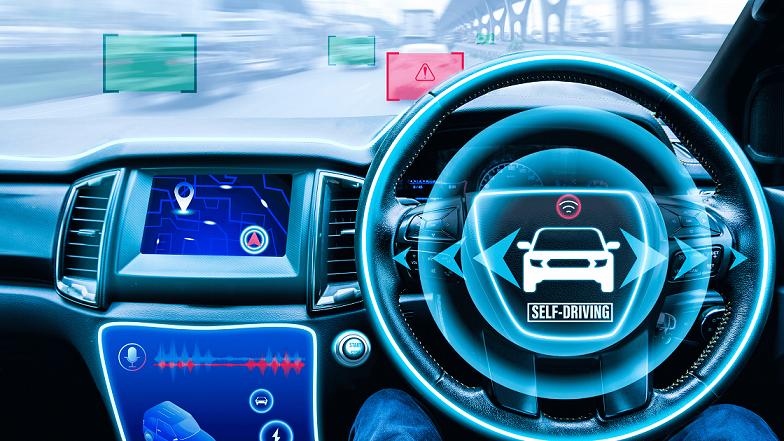
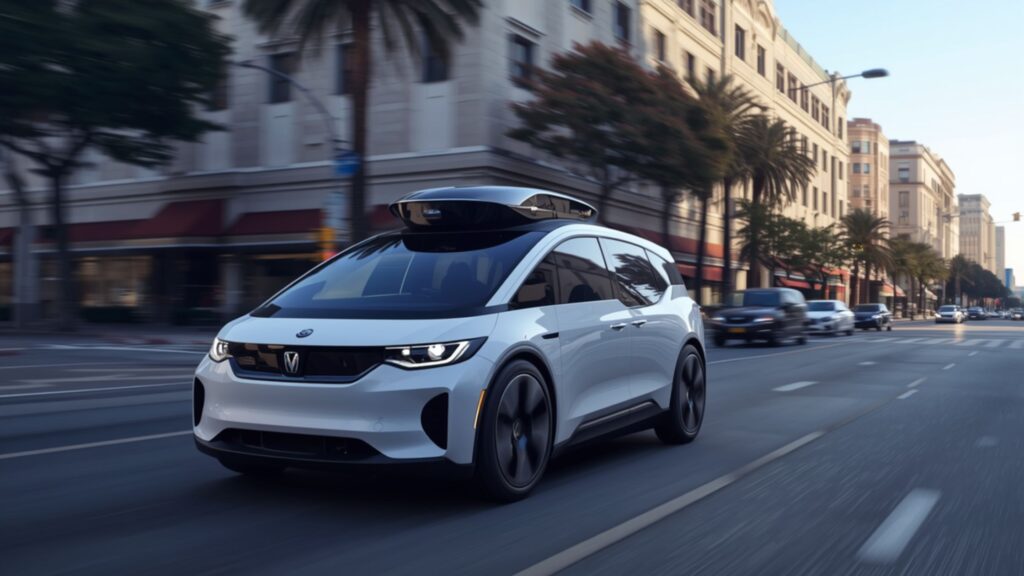
The autonomous vehicle industry is running a real business these days, and the numbers are real.
By the close of 2025, Waymo was completing over 450,000 paid rides every week across Phoenix, San Francisco, Los Angeles, and Austin. Baidu’s Apollo Go hit the same weekly milestone in China, now operating in 22 cities worldwide. The question has shifted from “will this work?” to “how fast does it scale?”
From Ownership to Access: Why the Model Had to Change
For many years now, our acquisition of cars has essentially been a capital expenditure problem. You bought the vehicle, insured it, maintained it, and used it maybe 4% of the time. The other 96%, it sat in a parking spot depreciating.
Younger generations noticed. Millennials and Gen Z have consistently shown lower interest in car ownership than any previous generations, particularly in dense urban areas where alternatives exist. Uber and Lyft spent billions proving that people will trade a monthly car payment for a frictionless app. The model worked. Ride-hailing normalized transportation-as-a-service. But there was always problems, like privacy and profitability.
Labor makes up roughly 57 to 70% of the cost of a human-driven ride-hailing fare. ARK Investment Management estimated that eliminating the driver could cut the per-mile cost by up to 88%, bringing autonomous rides down to around $0.25 per mile at scale. McKinsey’s research showed that 56% of consumers are open to replacing private vehicle trips with shared autonomous vehicles. The economic case for AV Mobility-as-a-Service just required the technology to actually arrive.
$1.275 trillion
Projected global Mobility-as-a-Service market size by 2031, up from $125.26 billion in 2023. CAGR of 33.65%. (Data Bridge Market Research
Waymo is the clearest case study. It’s been operating commercial rides since 2020 and has spent over $11 billion getting there. Revenue grew from roughly $2 million in 2022 to $125 million in 2024, with projections exceeding $1.3 billion by 2027. By March 2026, it had surpassed 500,000 weekly paid rides and was on track to hit 1 million rides per week before the year ends. Waymo’s valuation exceeded $45 billion after a $5.6 billion funding round in 2024, and the company has already driven more than 100 million fully autonomous miles on public roads.
Baidu’s Apollo Go is the dominant player in China and arguably the most aggressive operator globally. In February 2025, Baidu removed all safety drivers from its mainland China fleet. By May 2026, it was completing 500,000 fully driverless weekly orders. Cumulative rides passed 17 million, and the company is aggressively targeting profitability in 2026. Baidu’s sixth-generation robotaxi costs around $27,500 to manufacture, half the cost of its previous model.
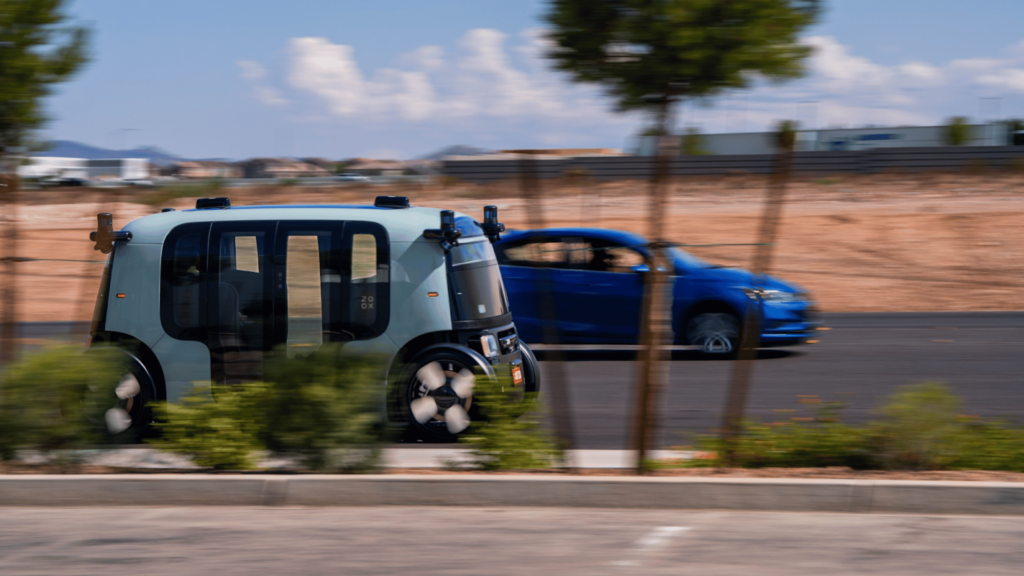
Amazon’s Zoox builds its vehicles from the ground up for autonomous use. No steering wheel, no pedals, bidirectional seating. In November 2025, Zoox opened public rides in San Francisco through its “Zoox Explorers” program. It opened a 220,000-square-foot factory in Hayward, California, capable of producing up to 10,000 vehicles annually. As of early 2026, it operates around 50 robotaxis across San Francisco and Las Vegas and is expanding into Seattle, Austin, Miami, Los Angeles, Atlanta, and Washington, D.C.
Tesla‘s approach is architecturally different. Rather than relying on lidars and HD maps, it has built a data moat. Millions of Tesla vehicles on the road feed real-world driving data into its neural networks every day. The Cybercab entered production at Gigafactory Texas in April 2026. It has no steering wheel, no pedals, and is targeted at under $30,000. Elon Musk put the operating cost goal at $0.20 per mile. Tesla also moved its Full Self-Driving feature to a subscription-only model at $99 per month in the US.
Wayve, a UK-based AI driving company, is building something different. Its AI doesn’t require pre-mapped roads. Wayve is teaching its AI to understand how to drive. It learns from real-world experience, just like a human driver does the first time they take the wheel in a new city. Wayve’s “AI-500 Roadshow” visited 90 cities in 90 days across three continents using a single AI model. As of February 2026, London-based AI driverless car startup Wayve has secured a massive $1.2 billion in Series D funding, with potential for an additional $300 million from Uber, bringing their total potential raise to $1.5 billion. This investment values the company at $8.6 billion.
The Real Economics: What Changes and What Doesn’t
Removing the driver is a step in the right direction, but AV MaaS doesn’t eliminate operating costs; it simply restructures them.
Sensor stacks, LiDAR arrays, onboard compute, and cameras still cost tens of thousands of dollars per vehicle. Remote operations centers require human operators monitoring feeds and intervening when edge cases arise. Insurance actuarial models for autonomous vehicles remain immature. Regulatory compliance heats the pressure in every market.
Still, costs are falling in the right direction. Goldman Sachs estimates the cost per robotaxi could drop below $50,000. Fleet operators already report at least a 30% reduction in operational costs through AI-optimized routing and maintenance scheduling. A personal car is used roughly 4% of the time. A robotaxi operating near continuously, only offline for charging and maintenance, greatly changes the per-mile economics at the asset level.
What autonomous operations actually look like in practice:
- No driver labor cost, which removes the largest single expense in traditional ride-hailing
- Higher vehicle utilization through AI dispatch, reducing the number of cars needed to meet a given demand level
- Fleet-wide OTA software updates, meaning the fleet improves continuously without hardware replacement
- Predictive maintenance through sensor data, reducing unplanned downtime
The transition from CAPEX (owning a vehicle) to OPEX (subscribing to transportation) is real and already underway for urban users who use Waymo daily. For cities, it opens the door to fleet procurement contracts. For employers, it opens up corporate mobility subscriptions. It’s an interesting business model.
The Partnership Network Driving Distribution
Technology alone doesn’t build a transportation business. You need riders, and the most efficient path to riders already exists in Uber and Lyft‘s installed user bases.
Waymo launched on the Uber platform in Austin in March 2025 and expanded to Atlanta in June 2025. In Phoenix, Waymo operates on both its own app and Uber’s, giving riders the option to switch to a driverless vehicle at the same fare they’ve already accepted. Baidu signed a multi-year deal with Uber in July 2025 to deploy Apollo Go vehicles on the Uber platform across Asia and the Middle East. One month later, it signed with Lyft to enter Germany and the UK. Zoox reached a separate integration agreement with Uber to match riders to its vehicles within defined geofenced zones. Wayve signed with Uber for London and with Nissan and Uber for a planned Tokyo pilot by late 2026.
Lyft is threading its own needle: partnering with May Mobility to deploy autonomous Toyota Siennas in Atlanta and Dallas, while simultaneously developing a proprietary robotaxi offering with Mobileye and Marubeni targeted at Dallas in 2026.
The Regulatory Reality
AV MaaS deployment isn’t as easy as it seems, and the reason isn’t technology. It’s politics and government regulations.
In the US, more than 35 states have passed some form of autonomous vehicle legislation, but there’s still no national framework. A vehicle that operates legally and autonomously in Phoenix needs entirely different permits in San Francisco. In the first months of 2025, lawmakers in 25 states introduced 67 new AV-related bills.
California maintains the most rigorous regulations globally: multiple approval stages, black-box recorders, detailed safety case documentation. Texas and Arizona have taken a relatively gentle approach, treating AVs much like any other vehicle, which is exactly why those states attracted early Waymo, Tesla, and Zoox deployments.
Germany legalized Level 4 autonomous driving in 2021 and has operated under a national framework since. The UK fast-tracked commercial AV pilots to spring 2026, cutting the original timeline from 2027 by over a year. China’s approach has been the most decisive: by February 2025, Baidu had removed all safety drivers from operations across mainland China.
Data governance cuts across all of this. AVs generate enormous volumes of real-world data every minute of operation. Who owns it, how regulators access it, and how it crosses borders are open questions in most jurisdictions. France moved in 2025 to mandate black-box recorders in all self-driving vehicles, establishing clear accident accountability. Most governments are watching and waiting. The companies that build trust with regulators early, through transparency and safety data sharing, are likely to gain competitive advantages that outlast any technology edge.
Consumer Trust
This is the part that typically tends to get glossed over. Most people are still scared.
AAA’s 2025 annual survey found that only 13% of US drivers say they trust self-driving vehicles. That’s up from 9% in 2024, but six in ten Americans still say they’re afraid, and 53% of those who are aware of robotaxis say they wouldn’t choose to ride in one. A knowledge gap persists too: only 43% of consumers can accurately define what a fully automated vehicle is.
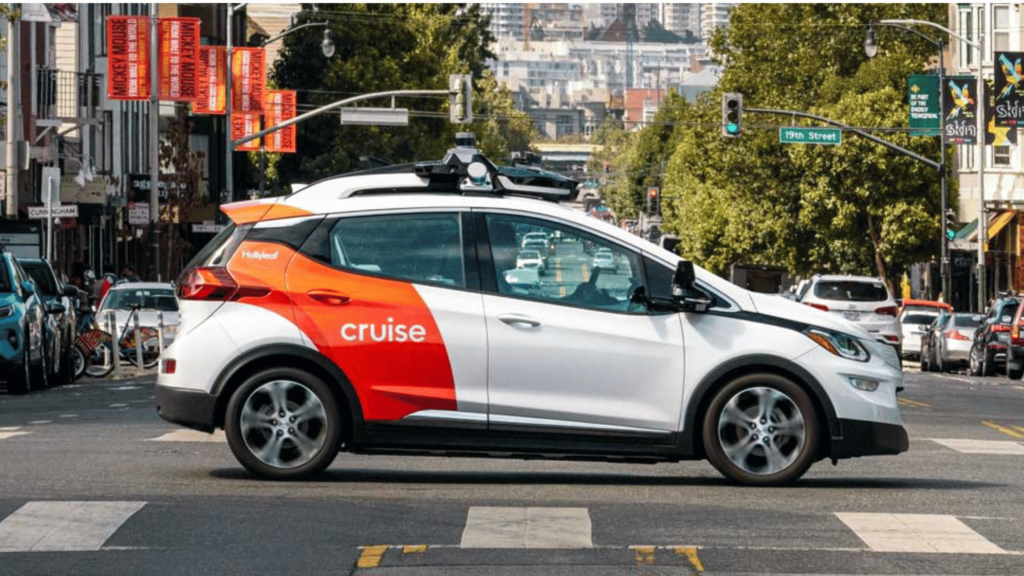
High-profile incidents disproportionately shape that fear. When GM’s Cruise dragged a pedestrian in San Francisco in 2023, the headlines moved public sentiment for months. A single event, amplified across social media and news cycles, can set back broader perception in ways that hundreds of thousands of uneventful rides don’t reverse.That’s just how humans build trust in new systems.
The generational picture is more encouraging. Gen Z shows roughly twice the comfort level with autonomous vehicles compared to Baby Boomers. Among people who say they feel informed about AV technology, 54% say they’d ride in one. Among those who know little, that drops to 32%. Rider education is necessary.
What the Next Five Years Actually Look Like
The robotaxi market is projected to grow from $0.4 billion in 2023 to $45.7 billion by 2030, at a CAGR of around 92%, according to Markets and Markets. The broader autonomous vehicle market sits at $273 billion in 2025, with some projections reaching $5.4 trillion by 2035 depending on the adoption model used.
Waymo is targeting 1 million rides per week by end of 2026 and has announced international expansions to London and Tokyo. Tesla’s Cybercab is in production with a stated goal of 2 million units per year at full capacity. Baidu is targeting unit-level profitability in 2025. Goldman Sachs sees robotaxi hardware costs falling below $50,000.
Three things will determine how fast the market actually matures. Regulatory balance, or at least consistency within major markets, needs to progress. Hardware costs need to continue to fall toward the $20,000 to $30,000 range, making fleet deployment financially sensible at scale. And people need more rides in these vehicles.
AV MaaS won’t replace every car or eliminate every bus route. But the direction of transportation, from owned asset to subscribed service, is no longer speculative. The companies are real, and so are the rides. The revenue is growing. The next question isn’t whether autonomous Mobility-as-a-Service will be successful. It’s who builds the fleet, the partnership network, and the regulatory relationships to win it first.
You May Also Like:
Top 20 US Autonomous Vehicle Companies (2026)
Autonomous Vehicle Funding More Than Triples in 2026, Hits Record $21.4 Billion

I’m Dr. Brandial Bright, also known as the AVangelist. As a dedicated and passionate researcher in autonomous and electric vehicles (AVs and EVs), my mission is to educate and raise awareness within the automotive industry. As the Founder and Managing Partner of Fifth Level Consulting, I promote the adoption and innovation of advanced vehicle technologies through speaking engagements, consulting, and research as we progress to level 5 fully autonomous vehicles.