Table of Contents
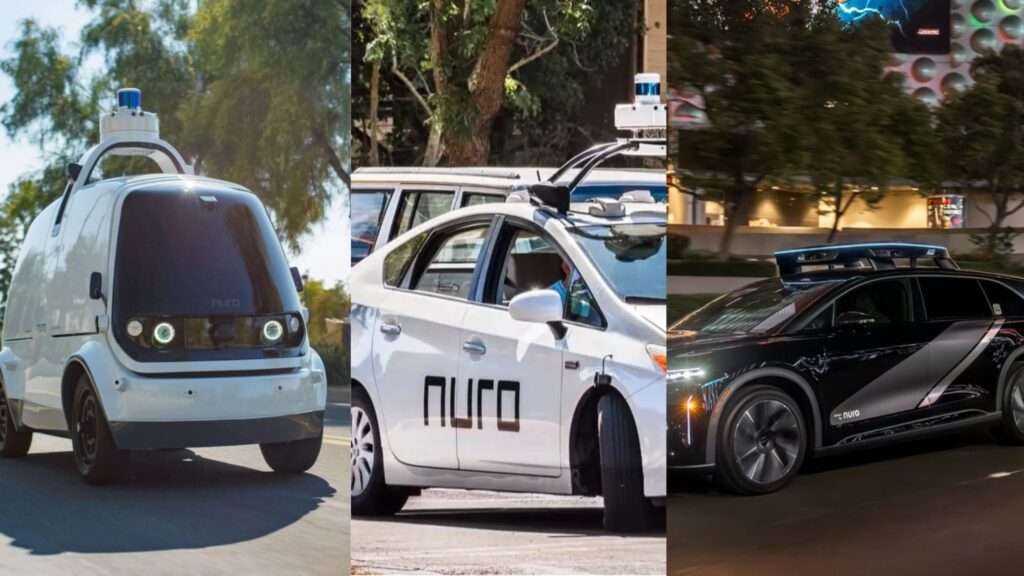
- Nuro pivoted from building custom delivery robots to licensing its Level 4 autonomous driving technology in September 2024, extending its business model beyond zero-occupant vehicles to passenger robotaxis and personally owned cars.
- The company partnered with Uber and Lucid Motors in July 2025 to deploy 20,000 robotaxis globally over six years, marking Nuro’s transition from goods delivery to passenger mobility services.
- Nuro achieved multiple industry firsts including becoming the first autonomous vehicle company to receive NHTSA exemption in 2020 and maintaining over 1.7 million driverless miles with zero at-fault incidents.
Nuro was founded in 2016 by Jiajun Zhu and Dave Ferguson, two former principal engineers from Google’s self-driving team (now Waymo). Jiajun Zhu joined Google’s self-driving initiative in 2009 as one of the founding team members, serving as the principal software engineer. Dave Ferguson joined in 2011 as the principal machine learning engineer, bringing expertise from Carnegie Mellon University where he’d led the planning group for the team that won the DARPA Urban Challenge in 2007.
In 2016, when Google prepared to spin out Waymo as a separate entity, Ferguson and Zhu chose to leave and take their payouts as a lump sum—court filings suggest each received around $40 million. That September, they founded Nuro Inc. in Mountain View, California.
Their first office was an Airbnb rental near Google’s campus.
Building Robots That Carry Packages, Not People
Americans make nearly 100 billion personal shopping trips every year. We drive to grocery stores, pharmacies, and restaurants to pick up things that could easily fit in a small vehicle. Each trip adds traffic, emissions, and hours lost to errands.
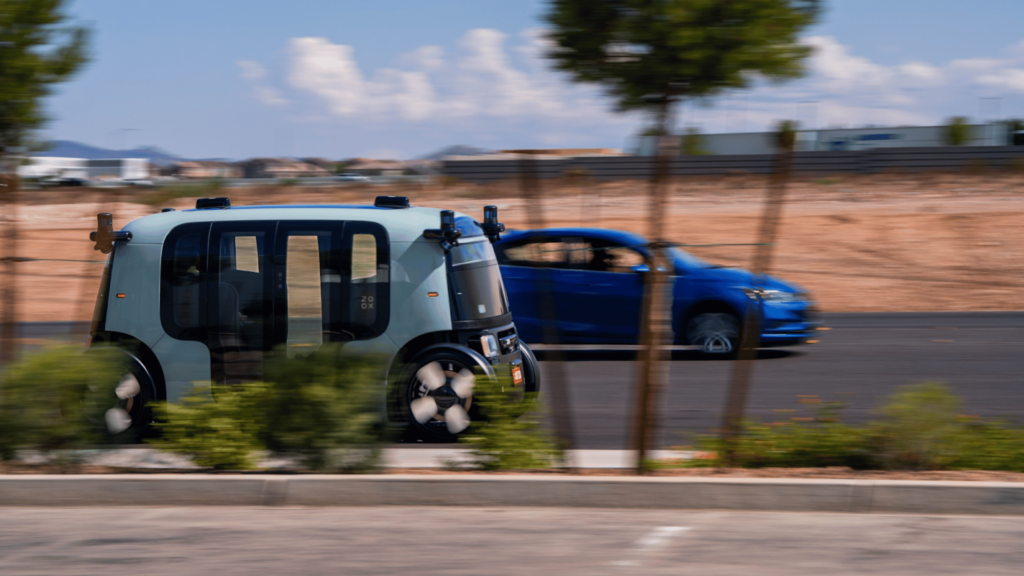
Nuro spotted this opportunity and built an autonomous vehicle designed exclusively for goods, not people. Without passengers, Nuro’s vehicles didn’t need steering wheels, mirrors, or windshields. They could be smaller, lighter, and safer for pedestrians.
The R1: First Steps on Public Roads (2018)
In January 2018, Nuro unveiled its first autonomous delivery vehicle with $92 million in funding from Greylock Partners and Gaorong Capital. The R1 weighed just 1,500 pounds and stood about half the width of a regular sedan.
The electric vehicle featured:
- Cargo capacity for approximately 12 grocery bags
- Full suite of sensors including radar, sonar, and lidar
- Custom design optimized for neighborhood delivery
- Zero emissions from battery-electric propulsion
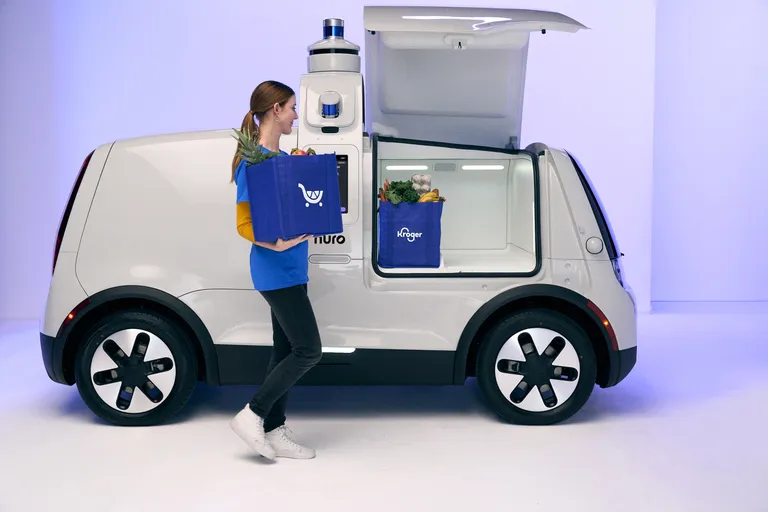
On August 16, 2018, Nuro launched the world’s first unmanned delivery service with Kroger in Scottsdale, Arizona. Customers could order groceries through an app and watch as the R1 navigated public roads to their doorsteps.

The R2: Industry-First NHTSA Exemption (2020)
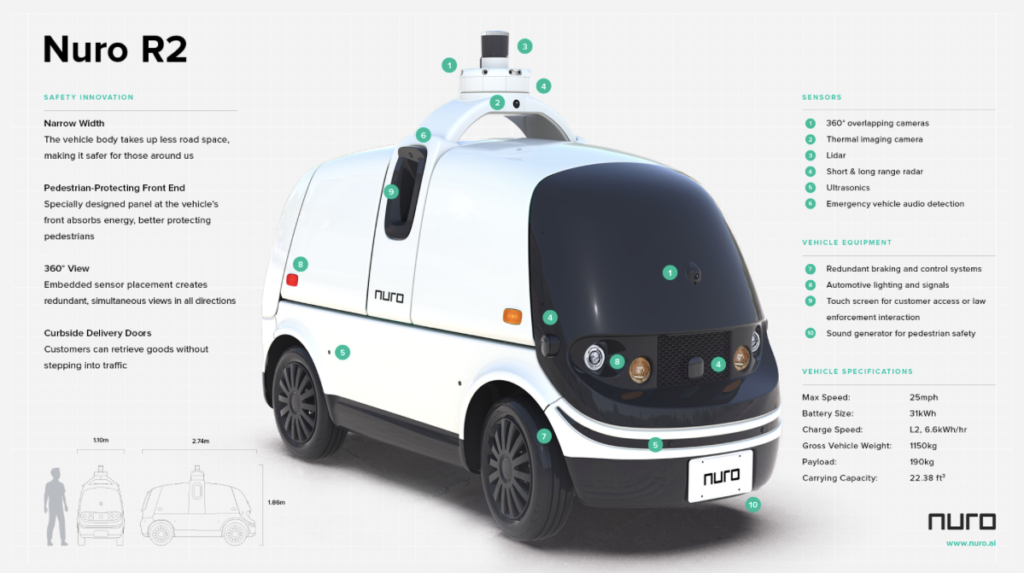
February 2020 marked a watershed moment for autonomous vehicles. The U.S. Department of Transportation’s National Highway Traffic Safety Administration (NHTSA) granted Nuro the first-ever exemption for a driverless vehicle.
The R2, Nuro’s second-generation delivery bot, received permission to operate without mirrors, a windshield, or a rear-view camera. This exemption followed three years of discussion with regulators.
“Since this is a low-speed self-driving delivery vehicle, certain features that the Department traditionally required—such as mirrors and a windshield for vehicles carrying drivers—no longer make sense,” said U.S. Secretary of Transportation Elaine L. Chao.
NHTSA permitted Nuro to deploy up to 5,000 R2 vehicles over a two-year period. The company began testing in Houston, expanding its commercial operations beyond Arizona.
Rapid Growth and High-Profile Partnerships (2019-2022)
Nuro soon became a darling of the autonomous vehicle industry, securing some serious partnerships.
February 2019: SoftBank Group led a $940 million Series C funding round, valuing Nuro at $2.7 billion.
June 2019: Nuro announced a partnership with Domino’s Pizza to test autonomous pizza deliveries in Houston using the R2 vehicle.
November 2020: The company closed a $500 million Series C funding round led by T. Rowe Price Associates, reaching a $5 billion valuation. Nuro also secured deals with Kruger, FedEx, Chipotle, 7-Eleven, Walmart, CVS Pharmacy, etc.
December 2020: Nuro acquired Ike Robotics, a self-driving trucking startup, signaling potential expansion into larger freight applications.
November 2021: Tiger Global Management led a $600 million Series D funding round, pushing Nuro’s valuation to an impressive $8.6 billion. The company had grown to more than 1,200 employees.
September 2022: Nuro and Uber announced a 10-year partnership for autonomous food deliveries through Uber Eats in California and Texas.
The Third Generation: The “Nuro” (2022)
In January 2022, Nuro unveiled its third-generation delivery vehicle—dropping the R-series nomenclature and simply calling it “Nuro.” Built in partnership with BYD North America, this flagship model represented a leap toward commercial scale:
- Twice the cargo volume of R2 (up to 500 pounds)
- Advanced HVAC system maintaining temperatures from 22°F to 116°F
- Modular, customizable compartments
- Top speed of 45 mph
- Enhanced exterior airbag system
- Automotive production-grade manufacturing
The company invested $40 million in a manufacturing facility and test track in southern Nevada, taking over 74 acres of the Las Vegas Motor Speedway for closed-course testing.
The Painful Pivot: Layoffs and Strategic Restructuring (2022-2023)
Nuro’s meteoric rise hit turbulence as economic conditions shifted. The company had over-hired during the 2021 funding boom, and macroeconomic headwinds forced difficult decisions.
November 2022: Nuro laid off approximately 300 employees—20% of its workforce. Co-founders Ferguson and Zhu took responsibility, acknowledging they’d expanded too aggressively during the “strongest fundraising environments in history.”
May 2023: Just six months later, another round of cuts eliminated 30% of staff (about 340 employees). The company paused plans to ramp up commercial operations and delayed volume production of its R3 delivery robot.
The restructuring aimed to extend Nuro’s capital runway from 1.5 years to 3.5 years by shifting resources from commercial deployment to core technology development. The company still had over $1 billion in the bank but needed a more sustainable path forward.
The Business Model Transformation: From Hardware to Software Licensing (September 2024)
In September 2024, Nuro announced a fundamental shift in strategy. After multiple rounds of layoffs and careful evaluation, the company pivoted from building and operating its own delivery fleet to licensing its autonomous driving technology.
The announcement marked a new chapter: Nuro would license the Nuro Driver—its Level 4 autonomous driving system—to automakers and mobility providers. This meant the company could finally move beyond zero-occupant delivery vehicles to enable:
- Level 4 robotaxis for ride-hailing services
- Personally owned autonomous vehicles
- Commercial fleet applications
- Full autonomous highway and surface street driving
“We believe that it’s within reach to provide [L4] on personally owned vehicles, so the consumer use case of full L4 technology is what we’re most excited about,” Dave Ferguson told TechCrunch.
The new business model offered two parallel strategies:
- Nuro Driver Level 4: Full autonomous driving capability for robotaxis and commercial applications
- Nuro Driver Assist Level 2++: Advanced driver assistance for consumer vehicles with a pathway to higher autonomy levels
The licensing approach eliminated the capital-intensive burden of manufacturing vehicles while monetizing Nuro’s core technological advantage—software that had already logged over 1 million autonomous miles with zero at-fault incidents.
Built on NVIDIA DRIVE Thor with the NVIDIA DriveOS operating system, the Nuro Driver featured:
- End-to-end AI model with safety safeguards
- Automotive-grade hardware designed for reliability and cost-efficiency
- Vehicle-agnostic platform adaptable to multiple platforms
- Geographic foundation model for real-time mapping
- Rapid adaptation to new environments and vehicle types
“It’s not a question of if, but when L4 autonomy will become widespread,” said Jiajun Zhu. “We believe Nuro is positioned to be a major contributor to this autonomous future.”
The Uber and Lucid Partnership: Entering Passenger Mobility (July 2025)
On July 17, 2025, Nuro made its biggest announcement yet. The company partnered with Lucid Motors and Uber Technologies to launch a global robotaxi program exclusively for the Uber platform.
The partnership combined three crucial elements:
- Lucid’s all-electric Gravity SUV with industry-leading 450-mile range
- Nuro’s proven Level 4 autonomous driving system
- Uber’s massive global mobility network (70 countries, 34 million trips daily)
Uber committed to deploying 20,000 or more Lucid vehicles equipped with the Nuro Driver over six years across dozens of markets worldwide. The first launch would occur in a major U.S. city in 2026.
“We’re thrilled to partner with Nuro and Lucid on this new robotaxi program, purpose-built just for the Uber platform, to safely bring the magic of autonomous driving to more people across the world,” said Dara Khosrowshahi, Uber’s CEO.
Why the Lucid Gravity Works for Robotaxis
Lucid’s Gravity SUV offered several advantages for autonomous operation:
- Extended range: 450 miles means less downtime for charging, maximizing vehicle availability
- Built-in redundancy: The Gravity already featured redundant electrical and controls architectures—critical for Level 3 capability and easily upgraded to Level 4
- Spacious interior: Room for up to six passengers with generous luggage space
- Software-defined architecture: Modern electrical architecture designed to support advanced autonomous systems
David Salguero, Nuro’s head of communications, noted that the Gravity conversion was easier than expected. “It has redundant braking and other features, so it wasn’t hard. The Gravity has long range and fast charging, and it will make a terrific luxury robotaxi.”
The hardware integration happens on Lucid’s assembly line in Casa Grande, Arizona. Lucid installs the necessary sensors and compute hardware, then Nuro’s software gets loaded when Uber commissions the vehicle.
You May Also Like:
6 Best Self-Driving Cars in the US (2026)
10 Best Self-Driving Electric Cars for 2026
Top 5 Autonomous Trucking Companies in the US (2026)
A Multi-Hundred-Million Dollar Investment
As part of the partnership, Uber made strategic investments in both companies. In September 2025, Lucid closed on a $300 million investment from Uber. Nuro also received significant backing as part of its Series E funding round.
In August 2025, Nuro raised $203 million in its Series E round at a $6 billion valuation. Key investors included:
- Uber Technologies
- NVIDIA
- T. Rowe Price
- Fidelity
- Tiger Global
- Woven Capital (Toyota’s venture arm)
CES 2026: Unveiling the Production Robotaxi (January 2026)
At the Consumer Electronics Show in January 2026, the three partners unveiled the production-intent Lucid Gravity robotaxi and showcased the Uber-designed in-cabin experience.
The production vehicle featured:
Sensor Suite:
- High-resolution cameras providing 360-degree perception
- Solid-state lidar sensors
- Radar systems
- All sensors integrated into the vehicle body and a low-profile roof-mounted “Halo” module
Compute Platform:
- NVIDIA DRIVE AGX Thor powering real-time AI processing
- Part of the NVIDIA DRIVE Hyperion platform
- Supports the advanced autonomous driving required for Level 4 operation
Passenger Experience Designed by Uber:
- Interactive touchscreens for controlling heated seats, climate, and music
- Real-time visualization showing what the robotaxi sees and its planned path
- Display of maneuvers like yielding to pedestrians, slowing at traffic lights, lane changes
- Ability to contact support or request the vehicle to pull over
- Exterior display showing passenger initials to help identify the correct vehicle
- Clear status updates from pickup through dropoff
On-Road Testing Begins in San Francisco Bay Area
The companies also announced that autonomous on-road testing had begun in December 2025; a critical milestone ahead of the expected commercial launch later in 2026.
Nuro leads the testing program using robotaxi engineering prototypes with autonomous vehicle operators supervising. Testing started in the San Francisco Bay Area, where all three companies maintain a presence.
“The debut of our production intent robotaxi with Lucid and Uber is a significant milestone on our path to delivering autonomy at scale,” said Dave Ferguson, who had been appointed Co-CEO alongside Zhu in October 2025. “By bringing together Nuro’s proven level 4 autonomy, Lucid’s advanced vehicle architecture, and Uber’s global reach, we’re building a robotaxi service designed for real-world operations and long-term growth.”
The testing follows Nuro’s comprehensive safety framework developed over years of commercial autonomous deployments.
As of February 2026, Nuro continues testing its robotaxis in the San Francisco Bay Area with commercial service expected to launch later in the year. The company maintains offices in Mountain View, California, and operates testing facilities in Nevada.
Also Read:
Physical AI in Autonomous Vehicles: How Will It Work?
Physical AI in Autonomous Vehicles? CES 2026 Key Highlights

I’m Dr. Brandial Bright, also known as the AVangelist. As a dedicated and passionate researcher in autonomous and electric vehicles (AVs and EVs), my mission is to educate and raise awareness within the automotive industry. As the Founder and Managing Partner of Fifth Level Consulting, I promote the adoption and innovation of advanced vehicle technologies through speaking engagements, consulting, and research as we progress to level 5 fully autonomous vehicles.