Table of Contents
The conversation around autonomous vehicles has grown over the years. While some industry leaders express doubt about the near-term success of self-driving cars, the technology is quietly but decisively proving itself on streets across the world. Lyft CEO David Risher recently declared there’s “zero likelihood” self-driving cars will replace human drivers in any reasonable timeframe, but the evidence unfolding in cities from San Francisco to Shanghai tells a very different story.
What Lyft’s CEO Said About Self-Driving Cars
At the Web Summit in Lisbon in November 2025, David Risher painted a cautious picture of autonomous vehicle adoption. Speaking to Fortune, he outlined multiple barriers he believes will keep self-driving cars from mainstream deployment for years to come.
“The [car manufacturers] aren’t entirely ready,” Risher explained. “The technology isn’t entirely ready for fog or snow or heavy rain or whatever it is. People, riders aren’t necessarily excited about it [and] regulators aren’t necessarily enthusiastic about it in every place.”
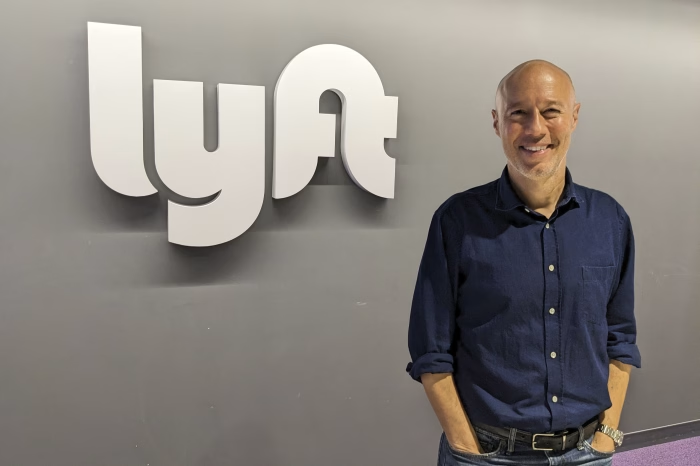
His skepticism extends beyond technology to economics. Risher argues that owning a fleet of self-driving cars becomes an expensive depreciation problem. Every night when passengers are asleep, these vehicles sit idle, their value diminishing. Add to that the maintenance, cleaning, and refueling costs that would fall entirely on the company rather than individual drivers, and the economics look less appealing than most people assume. Current autonomous vehicles cost between $250,000 to $300,000, he notes, compared to $30,000 or $40,000 for a typical Prius or Corolla.
Risher went so far as to say he’d be surprised if 10% of Lyft‘s business came from self-driving vehicles by 2030. From his perspective, the human driver model remains far more efficient for ride-hailing companies.
The Billion-Dollar Vision: What Other CEOs Are Seeing
While Risher expresses caution, other technology leaders are seeing something quite different unfolding on the horizon.
Nvidia’s CEO on the Multitrillion-Dollar Opportunity
At CES 2025 in January, Nvidia CEO Jensen Huang made a bold declaration that stands in stark contrast to Risher’s assessment.
“I predict that this will likely be the first multi-trillion-dollar robotics industry,” Huang announced, referring specifically to autonomous vehicles.
Huang’s confidence arises from Nvidia’s pivotal role in powering the AI systems that make self-driving cars possible. At his keynote, he unveiled Nvidia’s Cosmos platform, which uses generative AI to create synthetic driving scenarios that dramatically expand training datasets for autonomous vehicles. Using Omniverse and Cosmos, Nvidia’s AI data factory can scale “hundreds of drives into billions of effective miles,” Huang explained, addressing one of the key challenges in autonomous vehicle development.
The tech giant announced partnerships with Toyota, the world’s largest automaker, which will build its next-generation vehicles on Nvidia’s DRIVE AGX platform.
“Just as computer graphics was revolutionized at such an incredible pace, you’re going to see the pace of AV development increasing tremendously over the next several years,” Huang predicted.
With approximately one trillion miles driven around the world each year, the shift to highly or fully autonomous vehicles represents what he calls “the autonomous vehicle revolution.”
Uber’s CEO Sees a Trillion-Dollar Future
Uber CEO Dara Khosrowshahi has been equally optimistic, though perhaps more measured in his timeline. In a December 2025 interview with Bloomberg, Khosrowshahi described robotaxis as a “trillion-dollar-plus” business opportunity and predicted that within 15 to 20 years, virtually all cars will be autonomous.
His vision centers on safety as the primary driver of adoption.
“You fast forward 15, 20 years, I think that the autonomous driver is going to be a better driver than the human driver,” Khosrowshahi told the Wall Street Journal. “They will have trained on lifetimes of driving that no person can; they’re not going to be distracted.”
However, Khosrowshahi acknowledges significant hurdles before this vision becomes reality. Regulators must feel comfortable with the technology. The cost of autonomous vehicles need to drop to tens of thousands. Infrastructure like depots and charging stations must be built at scale. And consumers must be willing to ride in these vehicles in sufficient numbers to make the business profitable.
Uber has positioned itself not as a developer of autonomous technology but as an aggregator of self-driving services. The company now works with more than 20 autonomous vehicle partners, including Waymo, Baidu’s Apollo Go, WeRide, Wayve, etc., providing a platform for various autonomous technologies to reach riders.
The Safety Case: Waymo’s Remarkable Track Record
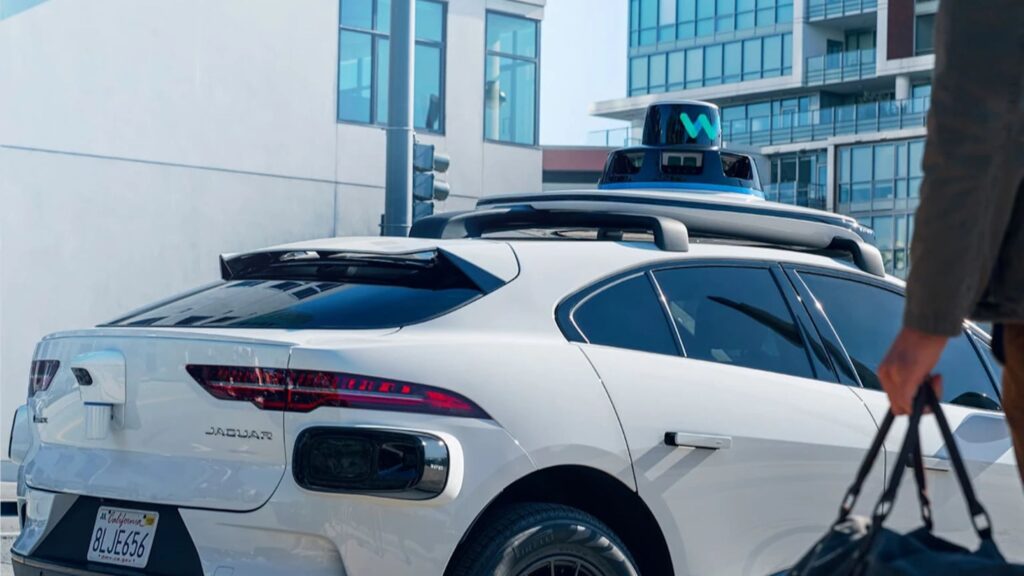
Perhaps the most compelling counterargument to Risher’s skepticism comes from the safety data emerging from autonomous vehicles already on the road. Waymo, Alphabet’s self-driving subsidiary, has accumulated evidence that directly challenges the notion that the technology isn’t ready.
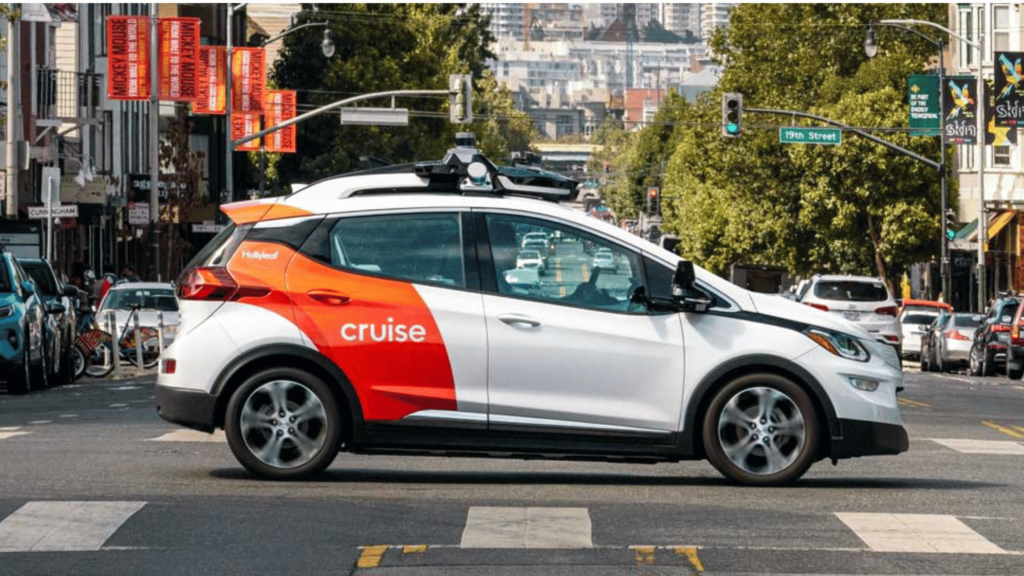
By September 2025, Waymo had driven more than 127 million fully autonomous “rider-only” miles without any human behind the wheel across four metropolitan areas: Phoenix (56.5 million miles), San Francisco (38.8 million miles), Los Angeles (25.5 million miles), and Austin (6.3 million miles). The company’s vehicles have proven dramatically safer than human drivers across virtually every crash category.
Compared to the average human driver covering the same distance in Waymo’s operating cities, the autonomous vehicles achieved:
- 90% fewer serious injury or worse crashes (27 fewer crashes)
- 82% fewer airbag deployment crashes (173 fewer crashes)
- 81% fewer injury-causing crashes (411 fewer crashes)
For vulnerable road users, the improvements are even more striking:
- 92% fewer pedestrian crashes with injuries (48 fewer crashes)
- 83% fewer cyclist crashes with injuries (28 fewer crashes)
- 80% fewer motorcycle crashes with injuries (20 fewer crashes)
I tell you, these aren’t just incremental improvements—they represent a fundamental leap in road safety.
Dr. Jonathan Slotkin, a neurosurgeon who analyzed Waymo’s data, wrote in The New York Times that “in medical research, there’s a practice of ending a study early when the results are too striking to ignore.” With more than 39,000 Americans dying in motor vehicle crashes annually, the implications of this level of safety improvement are profound.
What makes Waymo’s safety data particularly credible is the company’s comprehensive reporting approach. Unlike human drivers, where many minor incidents go unreported, Waymo reports all crashes involving their vehicles, including fender-benders that might not typically appear in official statistics. Even with this conservative approach to reporting, the safety advantages remain overwhelming.
Breaking Records: Waymo’s Milestone Achievements
Waymo’s progress in 2025 has been nothing short of remarkable. The company crossed several significant milestones that signals the technology’s swift development.
In 2025 alone, Waymo completed 14 million rides, tripling its annual ride count from the previous year. The company now provides more than 450,000 paid rides per week across its operating cities, making it by far the largest autonomous ride-hailing service in the world.
The economic equation is also improving rapidly. While Risher pointed to the high cost of autonomous vehicles as a barrier, Waymo has made significant progress in this area. The company’s sensor costs have declined to under $10,000 per vehicle, and Waymo is transitioning to more affordable platforms like the Hyundai Ioniq 5 and the Zeekr. The newest Waymo vehicles are expected to cost around $50,000 or less, a fraction of the earlier $250,000-$300,000 price tag Risher cited.
The company’s expansion plans are equally ambitious. Waymo announced plans to expand to more than 20 new cities by 2026, including international markets like Tokyo and London. The company is now either operating, planning to launch service, or testing vehicles in 26 markets worldwide.
Changing Hearts and Minds: Women’s Trust in Driverless Technology
One of the most interesting shifts in public perception centers on safety and privacy concerns, particularly among women. While overall trust in autonomous vehicles remains modest—only 13% of Americans expressed trust in self-driving vehicles in a 2025 AAA survey—those who have experienced the technology often become advocates.
Women, in particular, have emerged as strong supporters of driverless ride-hailing services, primarily for safety reasons. The elimination of a human driver addresses concerns about harassment, assault, or uncomfortable interactions that some women experience in traditional ride-hailing services.
Testimonials from Waymo riders frequently highlight this benefit. “I like being able to relax, not worry about having a stressful commute, and not having to question the driver’s decision-making abilities,” shared Sophia, a Phoenix rider. The privacy of autonomous rides offer a level of comfort that resonates with women traveling alone.
“I stopped using rideshares after a driver made inappropriate comments about my appearance during a late-night ride. When I tried Waymo, I felt an immediate sense of relief. There was no driver to worry about—just me and the car.” Samantha Davis, a 34-year-old nurse in Phoenix, shared her experience.
Waymo’s rides are “consistently safe,” as one rider put it. “It is almost as if I hail the exact same vehicle each time.” This consistency—the elimination of fickle driver behavior, mood, or judgment—signals a fundamental shift in the ride-hailing experience.
Tesla’s Robotaxi Ambitions: The Cybercab Vision
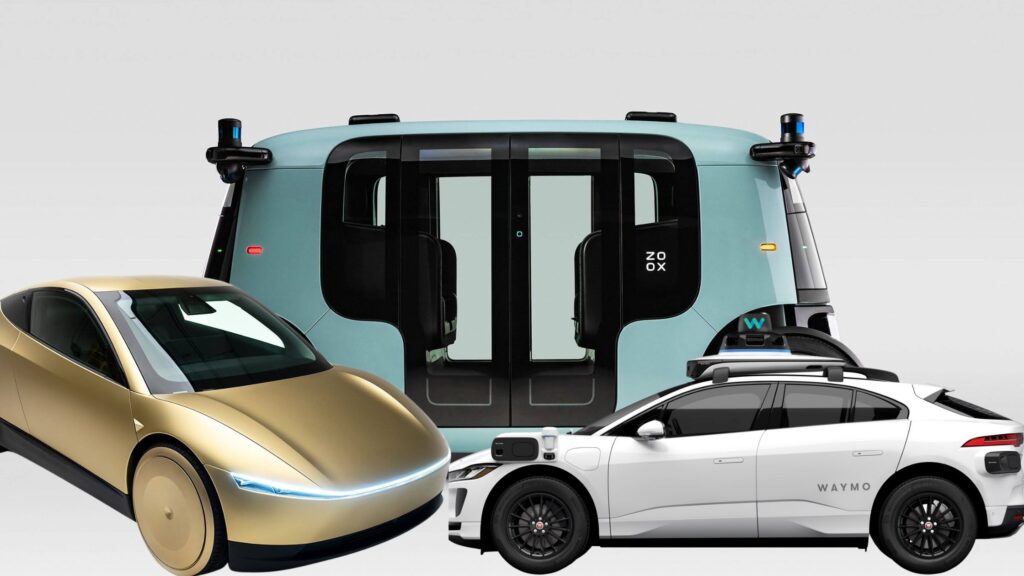
Tesla CEO Elon Musk has his own vision for the autonomous future, one that could potentially democratize access to robotaxi economics. At the “We, Robot” event in October 2024, Musk unveiled the Cybercab, Tesla’s purpose-built autonomous taxi.
The Cybercab is a striking two-passenger vehicle with no steering wheel or pedals, featuring butterfly doors and a Cybertruck-inspired aesthetic with front and rear light bars. The vehicle will charge wirelessly using inductive charging technology, eliminating the need for physical charging ports.
Most significantly, Musk announced that Tesla is targeting a price below $30,000 for the Cybercab, with production expected to begin before 2027. At this price point, the vehicle would be accessible not just to large fleet operators but potentially to individual owners who could add their vehicles to Tesla’s robotaxi network.
The economics Musk envisions are transformative. He estimates the Cybercab’s operating cost at around 20 cents per mile, with the cost to riders at 30 to 40 cents per mile—dramatically cheaper than current ride-hailing services and even more affordable than owning and operating a personal vehicle for most use cases.
Tesla has already begun testing aspects of this vision. In June 2025, the company launched its Robotaxi service in Austin, Texas, and expanded to the San Francisco Bay Area. While these vehicles still operate with human supervisors aboard as of late 2025, they indicate important steps toward Musk’s fully autonomous vision.
Amazon’s Unique Approach: Zoox’s Purpose-Built Robotaxi
Amazon’s Zoox has taken another approach: building autonomous vehicles from the ground up with no consideration for human drivers.
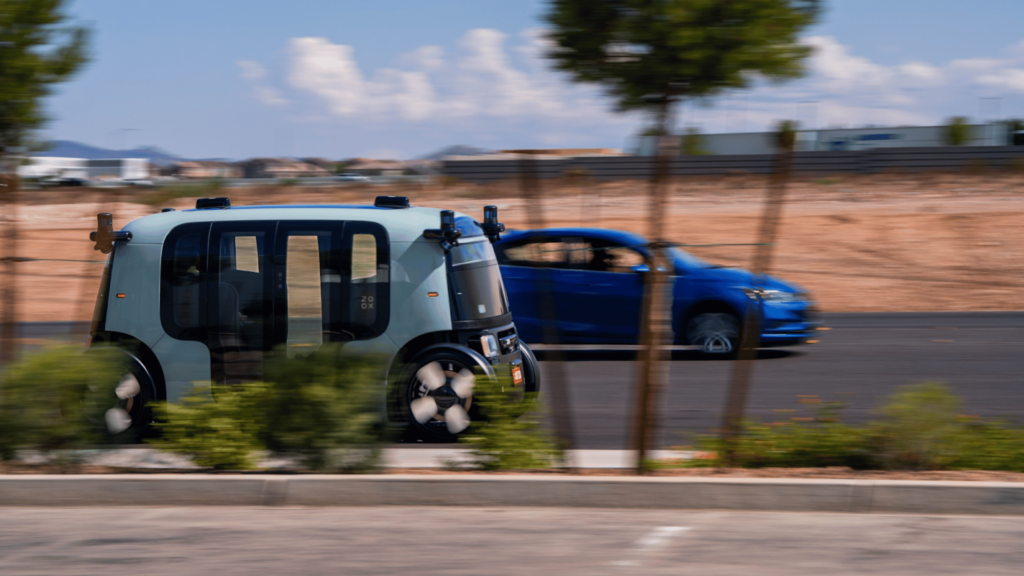
The Zoox robotaxi is unlike any vehicle on the road. It’s a boxy, toaster-shaped vehicle with no steering wheel, no pedals, and no front or back in the traditional sense. The vehicle is bidirectional, with wheels that can rotate to move forward or backward without turning around. Inside, four passengers sit facing each other in carriage-style seating, creating what Jesse Levinson, Zoox’s co-founder and CTO, calls “a dramatically more social” experience.
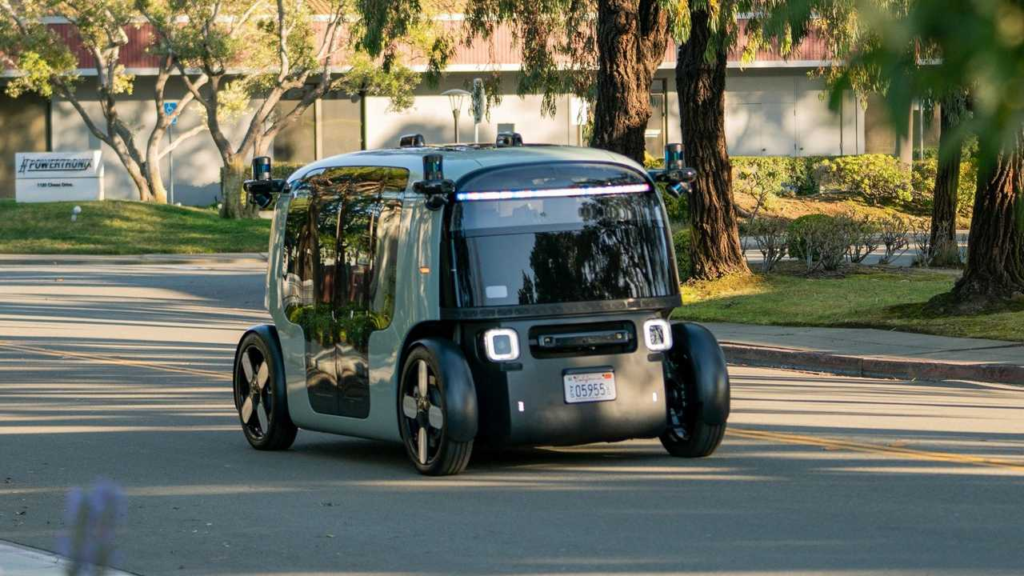
In September 2025, Zoox began offering free rides to the public around the Las Vegas Strip, marking its entry into the robotaxi market. The company expanded to San Francisco in November 2025, gradually opening its waitlist to more users. In December, Zoox announced plans to begin charging for rides in Las Vegas in early 2026, with paid San Francisco rides following later in the year.
Zoox crossed a significant milestone in late 2025, surpassing one million autonomous miles driven in its purpose-built fleet. While this pales in comparison to Waymo’s 127 million miles, it represents substantial progress for a company focused on demonstrating that purpose-built vehicles designed specifically for autonomy can offer a superior experience to retrofitted cars.
The company’s expansion plans are ambitious. Beyond Las Vegas and San Francisco, Zoox is preparing to test its robotaxis in Austin and Miami, and it operates retrofitted test vehicles in Atlanta, Los Angeles, Seattle, and Washington, D.C.
Baidu’s Global Expansion: Dominating in China and Beyond
While American companies like Waymo and Zoox dominate headlines in the U.S., Chinese tech giant Baidu has quietly built what may be the world’s most extensive autonomous ride-hailing operation through its Apollo Go service.
By August 2025, Apollo Go had completed more than 14 million passenger rides, with the service delivering 2.2 million fully driverless rides in the second quarter alone—a 148% surge from the previous year. The company operates a fleet of more than 1,000 autonomous vehicles across 16 cities worldwide.
Baidu’s sixth-generation autonomous vehicle, the RT6, costs less than $30,000 to manufacture, enabling the company to scale operations while maintaining profitability. This cost advantage is crucial: Baidu announced in late 2025 that its Apollo Go service had achieved per-vehicle profitability in Wuhan, where it operates its largest deployment in China.
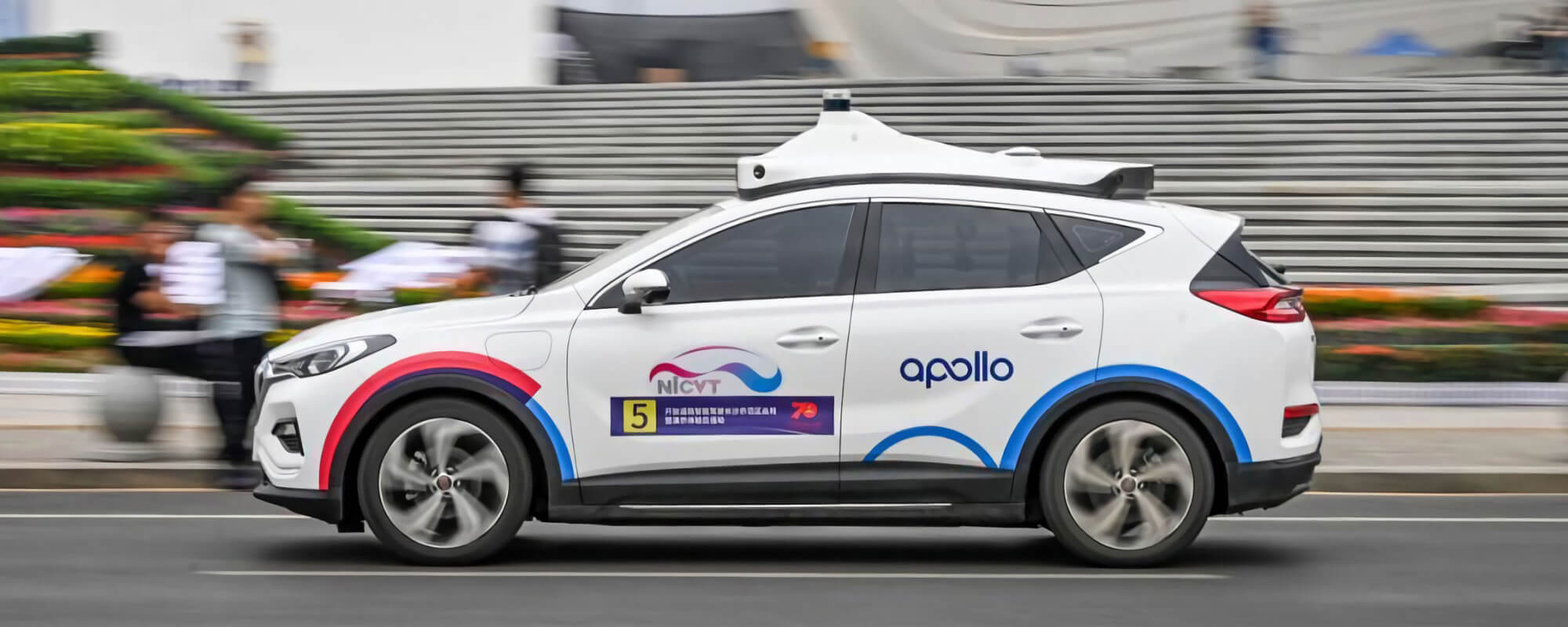
The company’s international expansion is accelerating. Baidu entered Hong Kong in November 2024, marking its first foray into a right-hand drive market. It began road testing in Dubai and Abu Dhabi in 2025. In July, Baidu struck a multi-year partnership with Uber to integrate thousands of Apollo Go vehicles into Uber’s platform across Asia, the Middle East, and other international markets. The following month, Baidu partnered with Lyft to bring Apollo Go to Europe, with service planned to debut in Germany and the UK in 2026.
Baidu CEO Robin Li sees a clear path forward.
“With a global fleet of over a thousand driverless vehicles, we’re reinforcing our position as the world’s leading autonomous ride-hailing provider,” he said in May 2025. “We believe Apollo Go will remain at the forefront of the industry and play a central role in Baidu’s long-term growth.”
The company’s success in China’s complex traffic environments—where it has achieved 100% fully driverless operations since February 2025—provides valuable experience for international expansion. As Li noted, “Once we can generate profit for every single car in a second-tier city [like Wuhan] in mainland China, we can generate profits in lots of cities across the world.”
Expert Voices on the Self-Driving Revolution
Industry experts and researchers increasingly view autonomous vehicles as inevitable, though timelines and implementation details remain subjects of debate.
David Zuby, Chief Research Officer at the Insurance Institute for Highway Safety (IIHS), praised Waymo’s transparency in sharing detailed crash data and miles driven.
“By making detailed information about crashes and miles driven publicly accessible, Waymo’s transparency will not only support independent research but foster public trust,” Zuby noted. “We hope other companies developing and deploying automated driving systems follow suit.”
However, not all expert voices are optimistic. Philip Koopman, an associate professor at Carnegie Mellon University, reminded a congressional hearing that “computers might never drink and drive, or text and drive. But computers are notoriously brittle when encountering something they have not been trained on.” He emphasized that “safe software is very difficult to create, and we should expect computer drivers to make mistakes. The question is how many they will make, and how severe they will be.”
Research institutions have also weighed in. A study by researchers at the University of Central Florida, analyzing 2,100 accidents involving autonomous vehicles and 35,000 accidents involving human drivers, found that autonomous vehicles generally show more safety than human-operated vehicles in most scenarios.
Srinivas Peeta, director of Georgia Tech’s autonomous and connected transport lab acknowledges that “the market finally seems to be at a tipping point for autonomous adoption.” However, he notes there’s still significant work to be done. “The question that comes up is when they’re faced with situations that they haven’t encountered previously,” Peeta explained. In some instances, humans are still able to adapt to various road conditions in ways that autonomous vehicles cannot—at least not yet.
The Partnership Ecosystem: Uber and Lyft Embrace Autonomy
Interestingly, both Uber and Lyft—the very companies that might seem most threatened by autonomous vehicles—have embraced the technology through strategic partnerships, even as their CEOs express different levels of optimism about the timeline.
Uber’s Multi-Partner Strategy
Uber has positioned itself as the platform where multiple autonomous technologies can reach riders. The company’s partnerships span the globe and include virtually every major player in autonomous vehicles.
In the U.S., Uber struck a landmark partnership with Waymo in 2024, making Waymo’s autonomous vehicles available through the Uber app in Austin beginning in early 2025, with Atlanta following in summer 2025. The partnership allows Uber to offer autonomous rides without developing the technology itself, while Waymo gains access to Uber’s massive rider base.
Internationally, Uber partnered with Baidu in July 2025 to deploy thousands of Apollo Go vehicles across Asia, the Middle East, and Europe. The company also works with WeRide and Pony.ai in various markets.
Uber’s strategy, as Khosrowshahi explained it, is to create “essentially a layer, kind of a pricing layer and routing layer, that will make the decision that based on what particular pickup should I send a human, should I send a robot, how should I price it.” Rather than viewing autonomous vehicles as replacing human drivers entirely, Uber envisions a hybrid model where both coexist, with the platform intelligently routing rides based on demand, location, and availability.
Lyft’s Selective Partnerships
Lyft, despite CEO David Risher’s public skepticism, has also pursued autonomous partnerships, albeit more selectively. The company partnered with Baidu in August 2025 to bring Apollo Go robotaxis to Europe, starting with Germany and the UK in 2026, pending regulatory approval.
Lyft previously partnered with Waymo before the pandemic but ended that relationship in 2020. The company has also worked with Motional, though that partnership faced challenges as Motional struggled financially. They also partnered withTensor Auto to deploy hundreds of robocars in Europe and North America.
The contrast between Risher’s public statements about autonomous vehicles and Lyft’s partnerships with AV companies reveals the complexity of the situation ride-hailing companies face. While there may be legitimate concerns about timing, economics, and regulatory readiness, the companies cannot afford to be left behind if autonomous technology does reach commercial viability faster than expected.
The Historical Parallel: Don’t Bet Against Transformative Technology
History offers sobering lessons for those who doubt transformative technologies. The pattern repeats with mind-boggling consistency: initial skepticism, gradual adoption, and eventual expansion that makes the old way seem insignificant.
Consider the airplane. When the Wright Brothers achieved powered flight in 1903, many dismissed it as a novelty with no practical application. Even prominent scientists and engineers declared heavier-than-air flight impossible or impractical. Yet within decades, aviation had revolutionized transportation, reshaped warfare, and begun to shrink the world in ways that would have seemed like science fiction to earlier generations.
The Internet followed a similar curve point. In 1995, astronomer Clifford Stoll wrote a Newsweek article titled “The Internet? Bah!” in which he declared: “The truth is no online database will replace your daily newspaper.” He couldn’t have been more wrong. Today, the internet revolves around virtually every aspect of modern life, from how we work and shop to how we maintain relationships and access information.
The pattern with self-driving cars looks interestingly similar. Initial skepticism focused on whether the technology could work at all. As companies like Waymo showcased it could work in limited conditions, skeptics shifted to concerns about scaling, weather conditions, edge cases, and economics. Now, as these vehicles rack up millions of miles and prove safer than human drivers, the objections have become more nuanced: regulatory readiness, public acceptance, cost structures.
But the trajectory is clear. Waymo alone is providing nearly half a million paid rides per week. Baidu is doing millions of rides quarterly in China. The technology works, it’s scaling, and it’s demonstrably safer than human driving. The question is no longer “if” but “when” and “how quickly.”
Companies and individuals who bet against such transformative technologies typically find themselves on the wrong side of history. Newspapers that dismissed the internet, film companies that ignored digital photography, and retailers that underestimated e-commerce all learned this lesson the hard way.
The self-driving revolution is here. The only question is how fast we’ll embrace it.
You May Also Like:
Is Zoox Robotaxi the Real Self-Driving Car?
Autonomous Shared Mobility Startup, Beep, is “Quietly” Breaking Records
2025 Waymo Safety Impact Compared with Human Drivers (in Waymo’s Operating Cities)

I’m Dr. Brandial Bright, also known as the AVangelist. As a dedicated and passionate researcher in autonomous and electric vehicles (AVs and EVs), my mission is to educate and raise awareness within the automotive industry. As the Founder and Managing Partner of Fifth Level Consulting, I promote the adoption and innovation of advanced vehicle technologies through speaking engagements, consulting, and research as we progress to level 5 fully autonomous vehicles.