Table of Contents
Jensen Huang stood on stage at CES 2026 in Las Vegas with a message that caught everyone’s attention. “The ChatGPT moment for physical AI is here — when machines begin to understand, reason and act in the real world,” the NVIDIA CEO declared.
He wasn’t talking about chatbots anymore. He was talking about cars.
Physical AI in autonomous vehicles represents a fundamental shift in how self-driving systems work.
According to research from Deloitte, physical AI refers to systems that enable machines to autonomously perceive, understand, reason about, and interact with the physical world in real time. These capabilities show up in robots, vehicles, simulations, and sensor systems. Unlike traditional robots that follow preprogrammed instructions, physical AI systems perceive their environment, learn from experience, and adapt their behavior based on real-time data.
It’s a complete rethinking of how autonomous systems make decisions.
What Makes Physical AI Different From Traditional Autonomous Driving
For years, self-driving cars have been reliant on modular pipelines. One module handles perception. Another predicts what other vehicles will do. A third plans the route. A fourth controls the steering wheel and brakes. Each piece works independently, passing information down the line.
The problem? Errors compound. If the perception module misidentifies a cyclist, that mistake ripples through every downstream decision. The system breaks down in ways that are hard to predict or fix.
Physical AI takes a different approach. It uses what researchers call vision-language-action (VLA) models. These unified frameworks process visual inputs from cameras, understand context through language reasoning, and output direct control commands — all in one integrated system.
Katie Driggs-Campbell, a professor specializing in autonomous systems, explained the distinction in coverage of NVIDIA’s CES announcements. Traditional neural networks make quick decisions but struggle to explain why. Foundation models like those in physical AI can reason through scenarios, even unfamiliar ones, by drawing on vast knowledge learned from internet-scale data.
The technical term is “chain-of-thought reasoning.” The car doesn’t just react. It thinks through the problem step by step, much like a human driver would.
Here’s what that looks like in practice. A physical AI system approaching an intersection might process: “I see a stop sign. There’s oncoming traffic from the left. A pedestrian is crossing from the right. I need to stop completely, wait for the pedestrian, then proceed when the intersection clears.” The system can articulate this logic in natural language.
Crucially, it can handle situations it’s never seen before. According to research published in autonomous driving surveys, VLA models integrate world knowledge from large-scale pre-trained vision-language models with domain-specific driving expertise. This means they can apply general reasoning to specific scenarios, rather than simply matching patterns from training data.
The NVIDIA Alpamayo Architecture
At CES 2026, Huang introduced Alpamayo, what NVIDIA calls “the world’s first thinking, reasoning autonomous vehicle AI.” The name comes from a Peruvian mountain peak, and the ambition matches that height.
Alpamayo is trained end-to-end, literally from camera input to vehicle actuation. The system takes in multiple camera feeds, radar and lidar data if available, plus vehicle state information. It processes all of this through approximately 10 billion parameters, the weights and connections that determine how the neural network interprets information.
The result? The vehicle explains why it’s making each decision.

During Huang’s presentation, he showed a video of an Alpamayo-powered vehicle navigating San Francisco traffic. The car smoothly handled lane changes, yielded to pedestrians, and navigated complex intersections. More importantly, it could verbalize its decision-making process at each step.
“Not only does your car drive as you would expect it to drive, it reasons about every scenario and tells you what it’s about to do,” Huang explained to the CES audience.
The architecture rests on three pillars, all released as open source:
Alpamayo R1, the core reasoning VLA model that handles perception, planning, and control through chain-of-thought processing. According to NVIDIA’s technical documentation, it’s the first openly available reasoning vision-language-action model specifically designed for autonomous vehicles.
AlpaSim, a complete simulation framework that creates photorealistic virtual environments for testing. This solves one of autonomous driving’s biggest challenges: you can’t safely test rare, dangerous scenarios on real roads. Simulation allows the AI to experience billions of virtual miles, encountering edge cases that might only happen once in a lifetime of actual driving.
Physical AI Open Datasets, containing over 1,700 hours of real-world driving data covering complex scenarios. This massive dataset includes human demonstrations, edge cases, and challenging weather conditions.
The system runs on NVIDIA’s DRIVE platform, powered by what Ali Kani, NVIDIA’s VP of automotive, described as compute that’s “hundreds of times larger” than previous vehicle computers. The chip architecture delivers 1,200 trillion floating-point operations per second while maintaining power efficiency suitable for automotive applications.
You May Also Like:
10 Best Self-Driving Electric Cars for 2026
6 Best Self-Driving Cars in the US (2026)
How Reasoning Changes Everything
The breakthrough isn’t just better pattern recognition. It’s genuine reasoning about cause and effect.
Traditional autonomous systems struggle with what researchers call “the long tail”—rare scenarios that don’t appear frequently in training data. A construction worker manually directing traffic. A mattress in the middle of the highway. A police officer’s hand signal overriding a traffic light.
These situations break rigid, rule-based systems. They’re too uncommon to have explicit programming for every variant.
Physical AI handles them differently. The reasoning model doesn’t just match what it sees to memorized patterns. It understands relationships. It grasps that a person in a reflective vest waving their arms in an intersection is trying to control traffic flow, even if the specific scenario is new.
Huang emphasized this point at CES:
“It’s impossible to get every single possible scenario in training data. But if you break tasks down and the AI can reason through them, it can understand situations it’s never encountered.”
The implications for safety are significant. According to the World Health Organization, road traffic accidents kill 1.19 million people yearly. In the United States, the National Highway Traffic Safety Administration reports that human error causes 94% of crashes. The leading factors are alcohol impairment (40%), speeding (30%), and reckless driving (33%).
Physical AI addresses these issues not by eliminating the human element entirely, but by providing a reasoning partner that never gets distracted, tired, or impaired.
The Training Pipeline: Three Computers Working Together
Huang described how NVIDIA trains physical AI for autonomous driving using what he calls “three computers.”
The first computer is a massive supercomputer built on NVIDIA’s GB300 architecture. This is where the initial training happens. The system learns from millions of hours of driving data; both real footage from test vehicles and synthetic data generated by simulation.
The second computer runs NVIDIA Omniverse with RTX graphics processors. This is the simulation engine. It creates photorealistic virtual worlds where the AI can practice driving. Not just simple scenarios, but complex urban environments with unpredictable pedestrians, aggressive drivers, construction zones, and weather conditions.
According to Huang’s technical explanation, this simulation capability is crucial: “We could have something that allows us to effectively travel billions, trillions of miles, but doing it inside a computer.”
The third computer is NVIDIA THOR, the automotive-grade processor that runs in the actual vehicle, taking the trained model and running it in real-time to make driving decisions.
Kai Stepper, VP of ADAS and autonomous driving at Lucid Motors, commented on this approach: “Advanced simulation environments, rich datasets and reasoning models are critical elements of autonomous driving evolution.”
Mercedes-Benz: First to Market
The 2026 Mercedes-Benz CLA became the first production vehicle to implement NVIDIA’s full autonomous driving stack powered by Alpamayo.
The partnership between NVIDIA and Mercedes-Benz goes back five years. According to Huang, the effort involved several thousand people from both companies to develop, integrate, and validate the technology.
Ola Källenius, CEO of Mercedes-Benz Group AG, appeared on stage with Huang at CES. He described test-driving the system through San Francisco and down into Silicon Valley using point-to-point navigation. “It’s a very sophisticated Level 2 system,” Källenius noted, stating the safety focus.
That Level 2+ designation is important. Despite advanced capabilities, the system still requires the human driver to maintain attention and be ready to take control. It’s not a robotaxi. Not yet.
But what it offers is significant. Mercedes calls it MB.DRIVE ASSIST PRO. The system combines navigation with driving assistance. You set a destination, and the car helps you get there, handling highways and urban streets. It manages lane changes, navigates intersections, notices pedestrians, and adjusts to traffic flow.
The unique aspect is “cooperative steering.” The vehicle assists, but the driver remains in command. The AI explains what it’s doing and why, creating transparency that builds trust.
The rollout timeline: United States in Q1 2026, Europe in Q2 2026, Asia later in 2026.
Beyond Tesla and Waymo: A Third Path
The autonomous driving industry has largely split into two camps.
Tesla pursues end-to-end neural networks trained on data from its millions of customer vehicles. The approach is aggressive, constantly pushing the boundaries of what’s possible with vision-only systems. But it’s entirely closed. Nobody outside Tesla can examine how Full Self-Driving works.
Waymo takes the opposite approach. Heavily engineered systems with lidar, detailed HD maps, and geofenced operation areas. It’s cautious, proven in specific environments, but quite difficult to scale broadly.
NVIDIA’s physical AI represents a third path. Open-source models that anyone can examine and build upon.
Real-World Performance: San Francisco Test Drives
The proof comes on actual streets. During CES week, NVIDIA and Mercedes conducted ride-alongs in San Francisco, allowing journalists and industry experts to experience the technology firsthand.
San Francisco presents some of the most challenging urban driving conditions in the world: steep hills, aggressive drivers, cyclists, pedestrians, construction, complex intersections where multiple streets converge at odd angles.
According to coverage from those who participated, the Alpamayo system handled it smoothly. Lane changes felt natural. The vehicle yielded appropriately to pedestrians. It navigated construction detours without human intervention. Most impressively, it could explain its decisions.
When asked why it slowed down at a particular intersection, the system might respond: “Detected a cyclist ahead signaling a lane change. Providing extra clearance for safety.”
This natural language interface is a significant advancement. Previous autonomous systems operated as black boxes. They made decisions, but couldn’t articulate why. Physical AI can communicate, turning the vehicle into a collaborative partner rather than a mysterious automation.
Xinzhou Wu, who leads NVIDIA’s automotive group, explained during the demonstrations that the system represents over four years of collaboration between NVIDIA and Mercedes. It’s not a proof of concept. It’s production-ready technology that has undergone extensive validation.
The hybrid stack Wu described pairs the end-to-end model with classical systems. In testing, this combination proved crucial. The neural network provides human-like driving feel and adaptability. The classical stack provides safety guarantees and regulatory compliance.
However, as with everything computerized, physical AI is not perfect. The solution involves continuous learning and improvement. Every unusual scenario the fleet encounters becomes training data for future model updates. Over-the-air updates allow vehicles to get smarter over time.
What 2026 and Beyond Holds
The timeline for physical AI deployment in autonomous vehicles is becoming concrete.
In the near term (2026-2027), expect Level 2+ systems like the Mercedes CLA to spread. These keep the human driver responsible but provide great assistance. Other automakers will adopt similar approaches, many building on NVIDIA’s open platform.
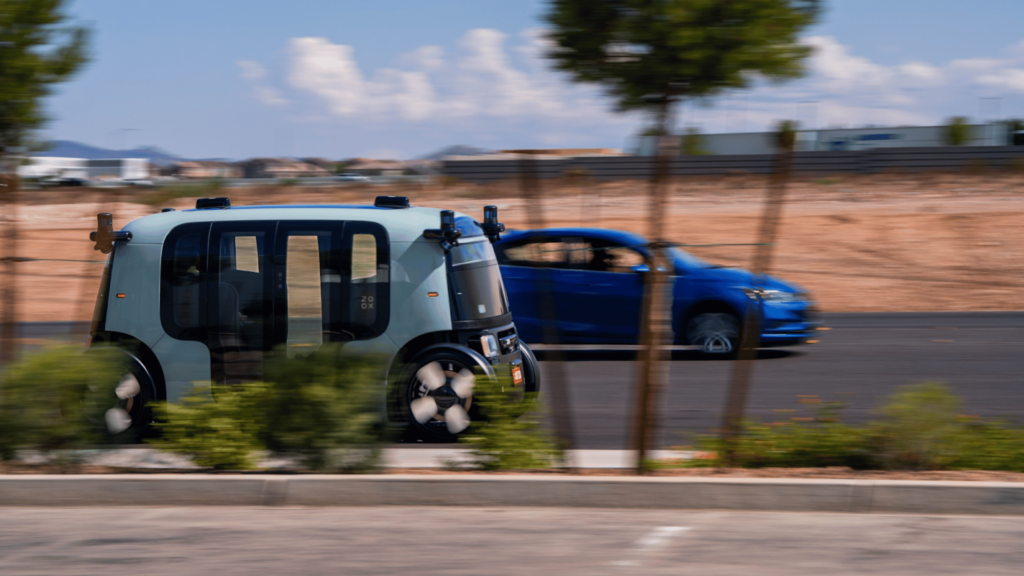
Robotaxi services represent the next major milestone. NVIDIA, partnering with Uber and others, targets Level 4 robotaxi deployment by 2027. These would operate in defined areas without human drivers, similar to current Waymo and Zoox services but potentially at larger scale due to the platform approach.
According to Huang’s projections, “In the next 10 years, I’m fairly certain a very, very large percentage of the world’s cars will be autonomous or highly autonomous.”
Goldman Sachs research projects that by 2030, end-to-end autonomous driving solutions dominated by VLA models could occupy 60% of the Level 4 autonomous driving market. That suggests physical AI becomes the dominant approach within this decade.
Also Read:
Will Self-Driving Cars Replace Human Drivers Anytime Soon?
Is Zoox Robotaxi the Real Self-Driving Car?
Physical AI in Autonomous Vehicles? CES 2026 Key Highlights

I’m Dr. Brandial Bright, also known as the AVangelist. As a dedicated and passionate researcher in autonomous and electric vehicles (AVs and EVs), my mission is to educate and raise awareness within the automotive industry. As the Founder and Managing Partner of Fifth Level Consulting, I promote the adoption and innovation of advanced vehicle technologies through speaking engagements, consulting, and research as we progress to level 5 fully autonomous vehicles.