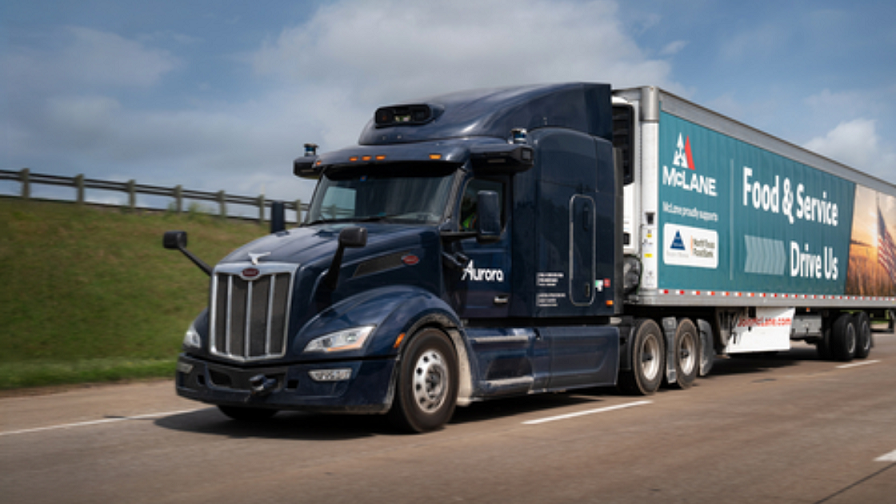
Aurora Innovation and McLane Company announced in May 2026 that they’re moving from a supervised pilot program to fully driverless commercial hauls between Dallas and Houston, Texas. It simply means that an AI-powered truck (with no safety driver) will load food supplies along 240 miles of highway.
How Big is McLane?
Many people haven’t heard of McLane Company. But if you’ve eaten at a chain restaurant or grabbed a snack at a convenience store in the U.S., you’ve almost certainly eaten something McLane moved.
McLane is a Berkshire Hathaway subsidiary and one of America’s largest distributors. The company serves chain restaurants, convenience stores, and mass merchants, moving food, beverages, and general merchandise across the country.
All around the world, moving perishables at scale is difficult. Demand can fluctuate, and the supply chain has very little room for delays. This is where autonomous trucking becomes attractive to a company like McLane.
How the Aurora-McLane Partnership Actually Works
Aurora and McLane started working together in 2023 with a supervised autonomy pilot. A human sat in the truck to observe. Over three years, Aurora’s self-driving system logged over 280,000 autonomous miles in Texas and completed about 1,400 loads for McLane, all with 100% on-time performance.
In 2026, McLane approved the transition to driverless operations on the Dallas-Houston corridor.
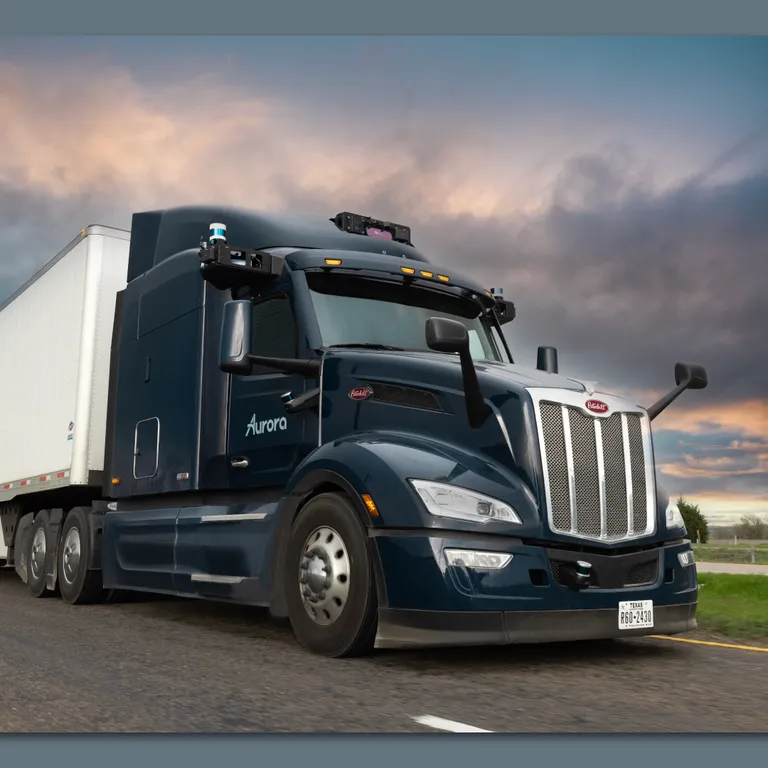
Aurora’s self-driving system, called the Aurora Driver, handles the long-haul “middle mile” between distribution centers. McLane’s human drivers then take over for the last-mile local deliveries directly to restaurant and retail locations. The trucks run two round-trips daily between Dallas and Houston, seven days a week.
Long-haul highway driving, especially on predictable, high-traffic corridors, is where autonomous systems perform best. Local delivery involves narrow streets, irregular stops, and customer interaction. Aurora and McLane aren’t trying to replace every driver. They’re automating the part of the job that’s most repetitive and most straining.
Why Dallas to Houston First?
The Dallas-Houston corridor is roughly 240 miles of mostly straight interstate highway. Freight demand is high. The corridor connects two of the country’s largest distribution hubs. Weather in Texas, while occasionally extreme, is far more temperate year-round than, say, Montana or Michigan. And Texas has been one of the most accommodating states for autonomous vehicle regulation.
Aurora’s network currently spans 12 distinct routes linking Phoenix, El Paso, Dallas-Fort Worth, Oklahoma City, Houston, and Laredo.
Texas Has Become the Hub for Autonomous Trucking
Interestingly, almost every autonomous trucking company has a Texas address or a Texas operation.
Kodiak Robotics completed a successful driverless freight run on the Dallas-Houston corridor in May 2026 and is now hauling commercially for Roehl Transport, one of America’s leading truckload carriers, running four roundtrips a week on that same lane. Kodiak had also deployed a fleet of 20 self-driving trucks in West Texas’s Permian Basin for Atlas Energy Solutions by late 2025.
Waabi, backed by Uber and Nvidia, opened an autonomous trucking terminal in Lancaster, just south of Dallas, in 2024. The company raised $200 million that same year and has been targeting driverless operations on the Dallas-Houston lane.
Plus AI, another competitor in the space, has been targeting similar Texas freight corridors.
Texas offers the combination of high freight volume, long straight highway corridors, friendly regulations, and major distribution infrastructure that makes this technology commercially viable right now.
You May Also Like:
Autonomous Freight Revolution: How Self-Driving Trucks Are Reshaping Global Supply Chains
Autonomous Vehicle Funding More Than Triples in 2026
Aurora’s Growth Strategy
Aurora was founded in 2017 by Chris Urmson, former chief technology officer of Google’s self-driving team (later Waymo), along with Sterling Anderson, former head of Tesla Autopilot, and Drew Bagnell, former head of Uber’s autonomy team. That founding team assembled some of the deepest autonomous vehicle expertise in the country.
The company’s commercial partnerships now include FedEx, Werner, Schneider, Hirschbach Motor Lines, Uber Freight, and Volvo Autonomous Solutions, in addition to McLane. Hirschbach agreed to buy 500 Aurora-powered trucks, per a memorandum of understanding expected to close in 2026. Aurora also hauls frac sand for Detmar Logistics.
On the hardware side, Aurora’s partnerships with truck manufacturers Volvo Trucks and PACCAR (maker of Kenworth and Peterbilt trucks) give it access to purpose-built autonomous platforms. In January 2025, Aurora, NVIDIA, and Continental announced a three-way partnership to mass-manufacture Aurora Driver hardware kits starting in 2027, with NVIDIA’s DRIVE Thor chip at the core.
Aurora is also backed by Amazon and Sequoia, among others, and had nearly $1.5 billion in cash and investments at the end of 2025. The company is not profitable yet. It posted a full-year net loss of $816 million in 2025, with revenue of $3 million. However, this is still a capital-intensive build phase for Aurora.
S&P Global forecasts project Aurora’s total revenue could reach $3.1 billion by 2030, anchored by $2.4 billion in trucking revenue, with a fleet scaling to over 12,000 trucks.
Aurora’s current goal is to exit 2026 with more than 200 driverless trucks in operation, which would generate an estimated $80 million annual revenue run rate. The company’s strategy shifts to a Driver-as-a-Service model in 2027, where customers own the trucks and Aurora licenses the driving system. The model could produce much higher margins.
The Driver Shortage Makes This More Urgent
The U.S. trucking industry had an estimated shortage of 60,000 to 80,000 qualified drivers in 2025. Projections suggest the gap will keep growing as the driver population ages. The average age of a U.S. truck driver is around 46. Annual turnover at large long-haul carriers regularly exceeds 90%. A federal rule that took effect in March 2026 bars asylum seekers, refugees, and DACA recipients from obtaining or renewing commercial driver’s licenses. The move could remove up to 200,000 drivers from the workforce over time.
Autonomous trucks running refrigerated hauls around the clock, without the labor issues that come with human drivers, directly address that pressure.
What’s Next?
Aurora plans to expand to new McLane routes across the U.S. Sun Belt by the end of 2026. A new fleet of driverless trucks built on the International LT series vehicle, without any human observer in the cab, is expected to begin scaled production through upfitter Roush this year, with initial capacity set at 1,000 trucks per year.
California’s DMV also approved new regulations in April 2026, allowing autonomous heavy-duty trucks on public roads, removing a restriction on vehicles over 10,001 pounds.
The food supply chain moves a lot of weight, quietly, every single day. Autonomous trucks won’t replace truck drivers overnight. But as it stands, the Aurora Driver is already doing the job and doing it well.
Also Read:
Top 5 Autonomous Trucking Companies in the US (2026)
Autonomous Mobility-As-A-Service (MaaS): The Future of Subscription-Based Transportation?

I’m Dr. Brandial Bright, also known as the AVangelist. As a dedicated and passionate researcher in autonomous and electric vehicles (AVs and EVs), my mission is to educate and raise awareness within the automotive industry. As the Founder and Managing Partner of Fifth Level Consulting, I promote the adoption and innovation of advanced vehicle technologies through speaking engagements, consulting, and research as we progress to level 5 fully autonomous vehicles.