We live in a world driven by convenience, which makes autonomous delivery a lifesaver—reshaping how we receive goods. One company at the forefront of this transformation is Nuro, a California-based robotics firm specializing in self-driving delivery vehicles. Unlike companies like Waymo or Tesla, which focus on passenger transport, Nuro has taken a different route—designing vehicles exclusively for goods, not people.
Founded in 2016 by Jiajun Zhu and Dave Ferguson, both former Google engineers, Nuro has quickly made a name for itself. It became the first company to receive an exemption from the National Highway Traffic Safety Administration (NHTSA) to operate autonomous vehicles without steering wheels, mirrors, or windshields. This milestone paved the way for fully autonomous deliveries in Texas, Arizona, and California.
Nuro’s impact extends beyond technology. It has secured partnerships with major brands like Domino’s, Kroger, Uber Eats, and FedEx, allowing companies to test and deploy self-driving deliveries at scale. With an estimated market valuation of $8.6 billion as of 2023, Nuro is not just an innovator—it’s a dominant force in autonomous logistics.
In 2024, Nuro secured another milestone in the autonomous vehicle industry. Instead of solely manufacturing its own delivery bots, the company is now licensing its AI-driven technology to other companies. This means automakers, delivery firms, and mobility startups could soon integrate Nuro’s self-driving system into their own fleets.
From regulatory firsts to high-profile collaborations and strategic business pivots, Nuro represents a unique case study in the autonomous vehicle revolution.
In this article, we’ll explore ten key facts about Nuro, including its cutting-edge safety features, sustainability initiatives, and the challenges it faces in an evolving market.
Amazing Key Facts About Nuro
1. Founders with a Strong Background in Robotics

Jiajun Zhu and Dave Ferguson, the co-founders of Nuro, both have extensive experience in robotics and artificial intelligence. Zhu was a key engineer in Google’s self-driving project, while Ferguson led machine learning efforts at Google and won the DARPA Urban Challenge in 2007 with his team from Carnegie Mellon University.
Jiajun Zhu served as a Principal Software Engineer at Google from 2008 to 2016, where he played a critical role in the development of Google’s self-driving car project, now known as Waymo. Zhu holds a Master’s Degree in Computer Science from the University of Virginia and a Bachelor’s Degree from Fudan University.
Ferguson joined Google in 2011 as the Principal Engineer and Machine Learning Lead for its self-driving car project. He led teams focused on computer vision, behavior prediction, and scene understanding, which are critical for autonomous vehicle functionality.
2. Focus on Autonomous Delivery Vehicles

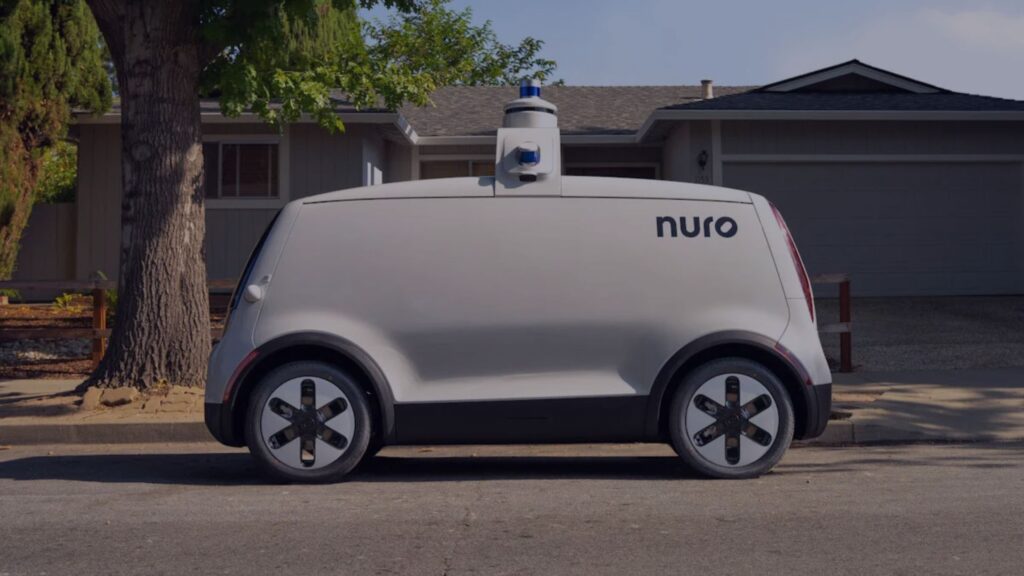
Unlike many autonomous vehicle companies that focus on passenger transportation, Nuro is solely dedicated to self-driving delivery for goods. This focus has allowed the company to design its vehicles from the ground up for efficiency, safety, and cost-effectiveness in last-mile logistics.
Nuro’s electric autonomous vehicles are not modified versions of existing cars—they are custom-built robots designed to transport goods, not passengers. This fundamental difference means that Nuro’s delivery bots don’t need standard vehicle components such as:
- Steering wheels
- Seats and seatbelts
- Rearview mirrors
- Windshields
Instead, the vehicle’s compact, narrow design prioritizes cargo space, pedestrian safety, and urban maneuverability. The latest version, Nuro R3, can carry up to 500 pounds of goods and has adjustable compartments to accommodate groceries, restaurant orders, or small parcels.
3. Innovative Vehicle Models

Nuro has designed several generations of autonomous delivery vehicles specifically tailored for transporting goods rather than passengers. The key models include:
- R1: Launched in 2018, the R1 was Nuro’s first electric self-driving vehicle, designed to carry cargo with a capacity equivalent to about 12 grocery bags. It was notable for its compact size and lack of traditional driving controls like steering wheels or pedals.
- R2: Introduced in 2020, the R2 featured enhanced safety features and was used for various delivery applications, including medical supplies during the COVID-19 pandemic. This model further solidified Nuro’s commitment to safe and efficient autonomous deliveries.
- R3: Recently approved for testing in California, the R3 represents a significant upgrade with capabilities to operate at higher speeds (up to 45 mph). Nuro’s R3 can carry up to 500 pounds of goods and has adjustable compartments to accommodate groceries, restaurant orders, or small parcels. This model is designed to expand Nuro’s operational domain and improve delivery efficiency across urban areas.
4. Nuro’s Vehicles are Powered by Nvidia Drive Thor

Nuro’s vehicles are equipped with state-of-the-art technology powered by NVIDIA DRIVE Thor™, enabling advanced AI capabilities for safe navigation in urban environments.
NVIDIA DRIVE Thor is NVIDIA’s latest autonomous vehicle computing platform, announced at CES 2025 as the successor to NVIDIA DRIVE Orin. It integrates AI-driven perception, planning, and control systems into a single-chip solution capable of handling 2,000 teraflops of processing power. This makes it one of the most advanced AI platforms for self-driving technology.
Nuro’s focus on developing scalable and performant tools supports ongoing advancements in autonomous driving technology.
5. First Autonomous Vehicle Deployment Permit

In December 2020, Nuro became the first company to receive an Autonomous Vehicle Deployment Permit from the California Department of Motor Vehicles (DMV). This milestone allowed Nuro to launch its commercial autonomous delivery service in California, marking a significant advancement in regulatory approval for autonomous vehicles.
6. The Nuro Driver
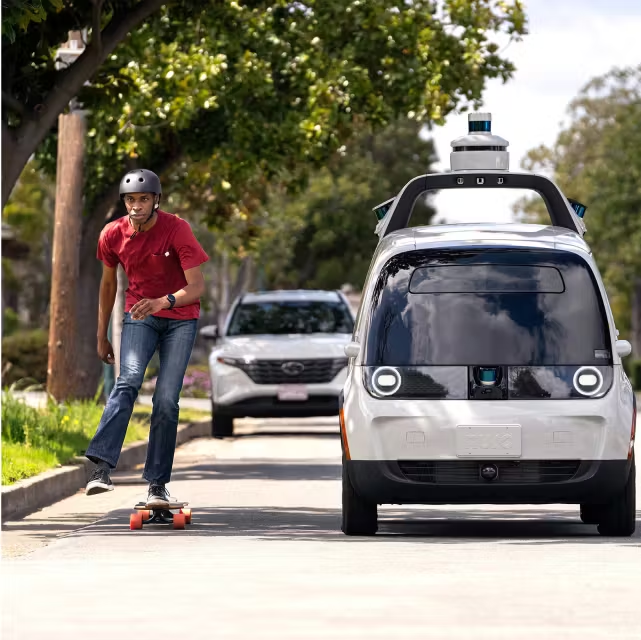
At the heart of Nuro’s autonomous delivery system is the Nuro Driver, an advanced AI-powered software stack that controls how the vehicles perceive, plan, and navigate through real-world environments. Nuro calls it a state-of-the-art AI technology designed to mimic safe natural driving behavior, integrating an end-to-end AI model with reliable safeguards for precision and reliability.
The Nuro Driver is built on deep learning algorithms, high-definition mapping, and real-time sensor fusion, allowing it to operate safely in complex urban settings. Nuro has deployed its AI driver in multiple U.S. cities, including Houston, Mountain View, and Phoenix, handling real-world deliveries for Kroger, Domino’s, and FedEx. Its ability to operate safely in mixed-traffic conditions has helped it secure key regulatory approvals, including an NHTSA exemption to operate without human controls.
7. Zero-At-Fault Incident Record

Nuro has logged over 1 million autonomous miles with zero at-fault incidents, underscoring its commitment to safety and reliability. This achievement demonstrates the effectiveness of Nuro’s technology (the “Nuro Driver”) in real-world scenarios and builds trust among consumers and regulators alike.
8. Partnerships with Major Retailers

Nuro has established itself as a key player in the autonomous vehicle sector through strategic partnerships with major retailers, significantly enhancing its operational capabilities and market reach.
One of its earliest and most notable collaborations began in 2018 with Kroger, one of the largest grocery chains in the United States. This partnership marked the launch of Nuro’s first autonomous delivery pilot, which allowed Kroger customers in Houston to receive groceries delivered by Nuro’s self-driving vehicles. The success of this pilot led to an expanded collaboration, where Nuro’s vehicles were integrated into Kroger’s logistics network, demonstrating the effectiveness of autonomous technology in everyday grocery delivery.
In addition to Kroger, Nuro has formed alliances with other prominent retailers such as Walmart and Domino’s Pizza. The partnership with Walmart aims to explore various delivery options, including grocery and general merchandise deliveries. This collaboration allowed Nuro to leverage Walmart’s extensive supply chain and customer base while providing Walmart with innovative solutions to meet the growing demand for delivery services.
Similarly, the agreement with Domino’s focuses on utilizing Nuro’s autonomous vehicles for pizza deliveries, showcasing the versatility of Nuro’s technology across different sectors.
Another significant partnership is with FedEx, which began in 2021. This multi-year agreement allows Nuro to test its autonomous delivery vehicles within FedEx’s operations, specifically for parcel logistics. The collaboration aims to enhance last-mile delivery efficiency by integrating Nuro’s technology into FedEx’s existing logistics framework.
Nuro also recently entered a 10-year partnership with Uber Technologies, which focuses on food deliveries through Uber Eats. The collaboration allows customers to order meals that will be delivered by Nuro’s autonomous vehicles, effectively combining Uber’s extensive platform with Nuro’s innovative delivery technology.

The initial rollout is set for Houston and Mountain View, California, with plans for future expansion.
During the COVID-19 pandemic, Nuro worked with healthcare providers to deliver medical supplies, demonstrating its adaptability and potential to serve essential sectors beyond grocery and food delivery.
Overall, Nuro’s partnerships with major retailers have been instrumental in advancing its mission of revolutionizing last-mile delivery through autonomous technology.
9. Recognition and Awards

The R2 vehicle by Nuro was awarded the title of “Best Self-Driving Delivery Vehicle” at the World Future Awards in July 2024. The recognition put the spotlight on Nuro’s innovation and effectiveness in transforming local commerce through autonomous delivery solutions.
Notably, the R2 is the first autonomous, zero-occupant vehicle approved for commercial delivery by the U.S. Department of Transportation and the National Highway Traffic Safety Administration (NHTSA). Its compact dimensions—less than one meter in width and shorter than the average human height—enhance pedestrian safety.
Equipped with a comprehensive suite of radar, sonar, lidar, and a 360-degree vision system, the R2 ensures thorough environmental awareness during operations. The vehicle’s interior is thoughtfully designed to maximize cargo space within its minimalistic exterior.
10. Nuro, Uber, and Lucid Deal
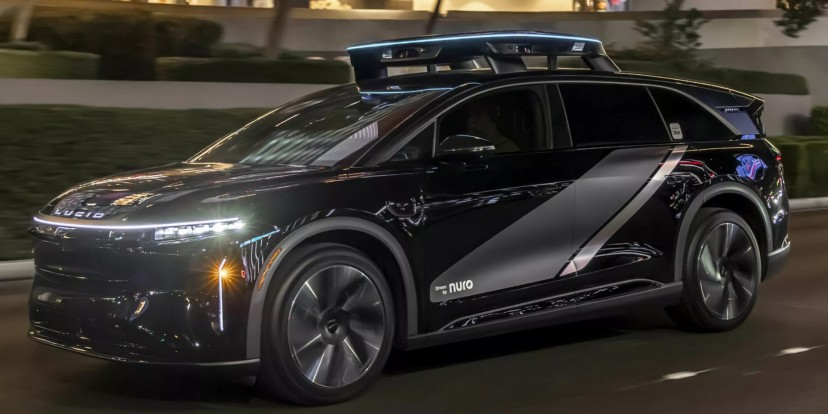
Once considered the “delivery bot company,” Nuro has spent the last nine months reinventing itself as a universal autonomy provider. At the Consumer Electronics Show (CES) in January 2026, Nuro unveiled the “Global Robotaxi”. This program is the fruit of a three-way partnership with Lucid and Uber. Nuro provides the “Nuro Driver” autonomy stack, Lucid provides its luxury Gravity SUV as the vehicle platform, and Uber serves as the exclusive commercial operator.
Uber has licensed the Nuro Driver system and plans to own and operate a fleet of over 20,000 autonomous Lucid Gravity SUVs over the next six years, with the first commercial rides expected in the San Francisco Bay Area by late 2026.
Nuro’s business model has been completely overhauled to favor a “licensing-first” approach. In April 2025, Nuro successfully closed a Series E funding round at a $6 billion valuation, bolstered by a strategic investment from NVIDIA.
The “Nuro Driver,” an end-to-end AI foundation model, surpassed 1.7 million autonomous miles in December 2025.
Conclusion
Nuro’s journey is a testament to how innovation, regulatory breakthroughs, and strategic partnerships can redefine utonomous trnsporttion.
One of the most compelling aspects of Nuro’s evolution is its ability to adapt. From securing the first-ever NHTSA exemption for a self-driving vehicle to forming solid partnership with Uber and Lucid, the company has demonstrated a clear vision for the future of the autonomous vehicle industry.
However, challenges remain. The autonomous vehicle industry is capital-intensive, and profitability is still a distant goal for most players. With companies like Waymo and Amazon’s Zoox competing for dominance, Nuro’s success will hinge on its ability to scale operations while maintaining regulatory compliance and consumer trust.
Looking ahead, Nuro’s pivot toward licensing its technology to automakers and mobility providers may be its smartest move yet. Strategically shifting away from direct vehicle production means that the company can embed its expertise into a broader ecosystem, allowing others to shoulder the manufacturing and operational costs.
You May Also Like:
- Ten Amazing Things to Know About Waymo in 2026
- 10 Interesting Things to Know About Kodiak Robotics in 2026
- Ten Things to Know About Aurora Innovation in 2026
- 10 Fascinating Things to Know About Nvidia (Key Facts)
- 10 Things You Should Know About Zoox After 10 Years Building Autonomous Vehicles
- Autonomous Mobility: 10 Fascinating Things to Know About the Tesla Cybercab (Tesla Robotaxi)

I’m Dr. Brandial Bright, also known as the AVangelist. As a dedicated and passionate researcher in autonomous and electric vehicles (AVs and EVs), my mission is to educate and raise awareness within the automotive industry. As the Founder and Managing Partner of Fifth Level Consulting, I promote the adoption and innovation of advanced vehicle technologies through speaking engagements, consulting, and research as we progress to level 5 fully autonomous vehicles.