
The autonomous vehicle industry is scaling rapidly, and one company is trying to do things differently—that’s Wayve. This British AV startup is changing the game with its self-driving technology.
Instead of teaching cars to memorize roads, Wayve is teaching them to understand how to drive. Its AI learns from real-world experience, just like a human driver does the first time they take the wheel in a new city.
Its cars can adapt to unfamiliar roads. They do not depend on high-definition maps. This means they can be deployed faster, cheaper, and at a global scale.
Wayve has captured the attention of some of the biggest names in technology, resulting in billions of dollars in investment.
In this guide, we unpack the key facts about Wayve—from its origin story and core technology to its rapid rise, partnerships, and expanding footprint in North America and beyond.
Key Facts About Wayve
1. Founded in a Cambridge Garage

Wayve was born in 2017 in a residential house just outside Cambridge University. Two PhD students, Alex Kendall and Amar Shah, started the company with a radical idea that most people never understood.
At the time, everyone in the industry believed self-driving cars needed detailed 3D maps, multiple sensors, and rule-based systems. Kendall and Shah proposed something different: teach a car to drive using deep learning, just like humans learn through experience.
Kendall’s groundbreaking research at Cambridge University’s Machine Intelligence Laboratory showed it was possible. He developed end-to-end deep learning algorithms that could teach machines to understand their surroundings and make driving decisions using computer vision alone.
The founders rented a house, built a prototype in the garage, and raised $3 million in seed funding. Their first investors were skeptical. Many told them flat out that their approach would “never be safe.” But Kendall, a New Zealand native who won prestigious awards for his PhD research, held firm.
By 2018, Wayve achieved something nobody had done before. They demonstrated the world’s first end-to-end deep learning system driving on public roads. The car learned to navigate streets it had never seen before using only cameras, basic GPS, and AI.
2. The AI That Learns to Drive Without Maps

Most self-driving cars are robots following instructions. They need high-definition maps showing every lane, traffic light, and road marking. Change a street layout, and the system fails.
Wayve took a different path.
Their AI Driver software uses what’s called “embodied intelligence.” The system learns from real-world driving data, building its own understanding of how roads work. No pre-mapped routes. No geofencing. No city-specific programming.
The technology is powered by foundation models trained on vast amounts of real-world driving data. These models learn transferable driving behaviors. The system can adapt to a new city with minimal additional training.
It’s entirely different from what competitors are doing. The company calls this approach AV2.0—the next generation of autonomous vehicles that rely on AI learning rather than hard-coded rules.
3. Testing in Over 500 Cities Without Prior Training

In 2025, Wayve accomplished something outstanding. They took their AI Driver on a global road trip, testing it in over 500 cities across Europe, North America, and Asia—all without any prior training in those locations.
This is called “zero-shot” driving. The AI drove in places it had never seen before, with no city-specific fine-tuning.
The system worked.
Testing in Germany showed a 3X performance boost compared to initial US testing. This is because each new environment makes the AI smarter. The diverse data exposure strengthens the foundation model, improving performance everywhere.
When Wayve transitioned to a new vehicle platform, they achieved an 8X performance improvement after just 100 hours of vehicle-specific data collection.
4. $8.6 Billion Valuation After Record-Breaking Funding

In February 2026, Wayve secured $1.5 billion in total funding, including a $1.2 billion Series D round. The post-money valuation reached $8.6 billion, making Wayve one of Europe’s most valuable AI startups.
The investor list includes big industry players:
- Microsoft (returning investor)
- NVIDIA (returning investor)
- Uber (strategic partner and investor)
- SoftBank Vision Fund 2
- Mercedes-Benz
- Nissan
- Stellantis
- Ontario Teachers’ Pension Plan
- Baillie Gifford
- British Business Bank
It’s one of the largest AI funding rounds in European history.
Microsoft Chairman Satya Nadella stated that Wayve is “pushing the frontier of embodied AI for autonomous driving” and that Azure provides the infrastructure needed to bring innovation to scaled commercial deployment.
5. Pioneering GAIA and LINGO AI Models

GAIA (Generative AI for Autonomy) is the world’s first generative world model specifically designed for autonomous driving. The latest version, GAIA-3, contains 15 billion parameters—double the size of its predecessor.
What does GAIA do? It generates realistic driving videos by predicting future scenarios. Feed it a few seconds of video, and it can simulate what might happen next. The system can generate night-time driving scenes with snow, predict how pedestrians will move, or show how traffic lights will change.
This is essential for safety testing. Real-world dangerous situations are too risky to practice. GAIA creates synthetic scenarios where the AI can learn to handle rare, safety-critical events without putting anyone at risk.
LINGO is equally revolutionary. It’s a vision-language-action model that lets the AI explain its driving decisions in natural language. Ask it why it stopped, and it can tell you: “There’s a pedestrian crossing ahead.” Request a specific driving style, and it adapts.
LINGO-2, tested on public roads, provides continuous driving commentary, explaining motion planning decisions in real-time. The transparency helps engineers understand how the AI thinks and helps build trust with passengers.
6. Strategic US Expansion in San Francisco

In October 2024, Wayve planted its flag in America. The company opened a new office in Sunnyvale, California, and launched its first testing program outside the UK in San Francisco and the Bay Area.
San Francisco is one of the most challenging driving environments in America. If the AI can handle San Francisco, it can handle most American cities.
The testing focuses on Advanced Driver Assistance Systems (ADAS)—features that support drivers rather than replace them entirely. This gives Wayve real-world data while building toward full autonomy.
The Sunnyvale office houses a team focused on software development, hardware integration, and deployment operations. It’s a full engineering hub designed to support North American expansion.
7. Nissan Partnership Brings Production Vehicles in 2027

In December 2025, Wayve signed definitive agreements with Nissan.The company will integrate Wayve’s AI Driver into its next-generation ProPILOT advanced driver assistance system. The first vehicles will launch in Japan in fiscal year 2027, with North America and other markets following shortly after.
The deal makes Nissan the first major automaker to commit to deploying Wayve’s AI at scale across multiple vehicle segments. We’re talking mass-produced consumer vehicles that regular people will buy and drive.
The system combines Wayve’s embodied AI software with Nissan’s Ground Truth Perception technology and next-generation LiDAR. It will offer Level 2+ capability initially—hands-off driving under supervision on highways and urban roads.
Nissan President Ivan Espinosa called it “a new benchmark for driver assistance” that will “deliver safer, more intuitive and more comfortable driving experiences to customers worldwide.”
Mercedes-Benz and Stellantis have also invested in Wayve. Similar production partnerships may be coming.
8. Uber Robotaxi Launch Starting in London 2026

Wayve and Uber announced plans to launch commercial robotaxi trials in 2026, with London as the first market.
Under the partnership structure, Wayve provides the AI Driver software running at Level 4 (fully autonomous). Uber owns and operates the fleet, managing the business side. The vehicles will be mass-produced electric cars from participating automakers equipped with Wayve’s technology.
Uber CEO Dara Khosrowshahi stated they plan to deploy Wayve technology “in more than 10 markets around the world.”
Wayve has been testing in London since 2018. The company knows the regulatory environment. The UK government has fast-tracked autonomous vehicle legislation to support commercial deployment.
Waymo has also announced plans to launch in London the same year, setting up a direct head-to-head competition in one of the world’s most difficult driving environments.
9. Competing in the Global Robotaxi Race

The autonomous vehicle industry is heating up globally, and Wayve is proving to be a strong contender.
Baidu’s Apollo Go currently dominates in China, completing 20 million total trips with over 240 million fully driverless kilometers traveled. The service operates in multiple Chinese cities including Beijing, Wuhan, and Shenzhen, offering rides through a dedicated app.
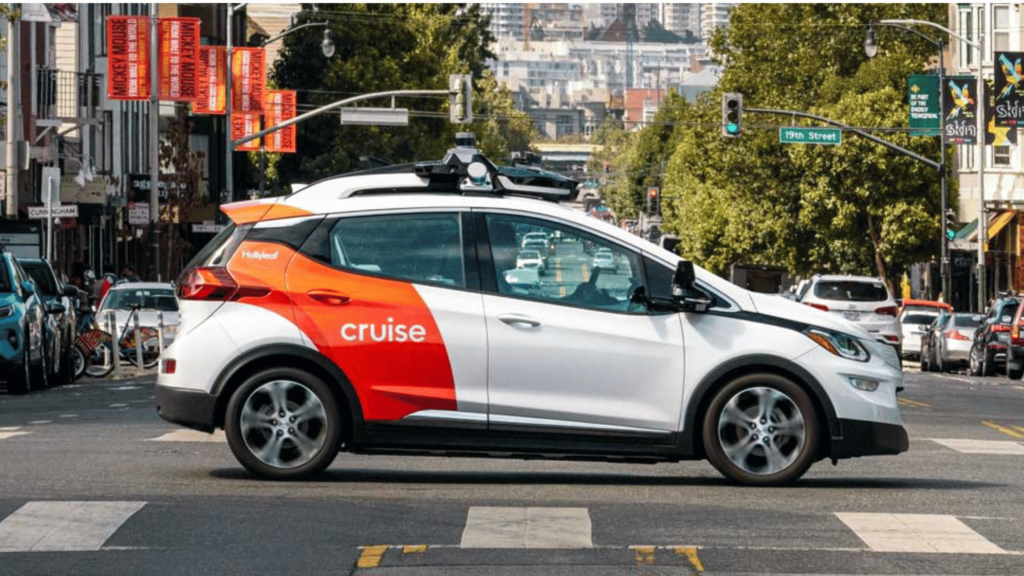
Waymo leads in the United States, providing over 400,000 rides per week in its service areas. The company recently raised $16 billion, signaling an aggressive expansion plan.
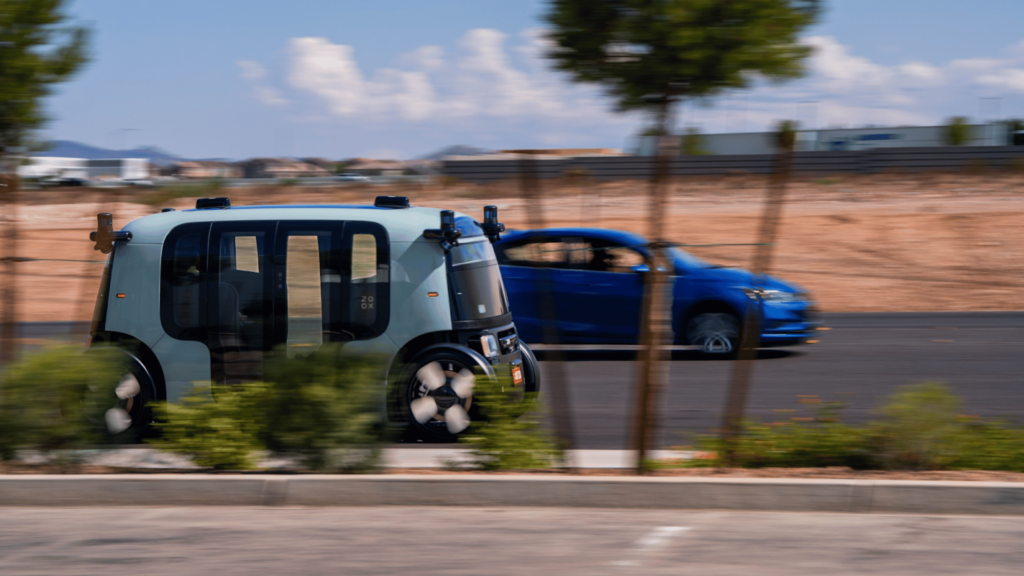
Tesla is ramping up its Level 4 fully autonomous operations, and Amazon’s Zoox is fully functional in Las Vegas.
Where does Wayve fit in this landscape? They’re not competing on ride volume or current market share. They’re competing on technology architecture and the potential to be scalable.
Wayve, through OEM partnerships, will ultimately reach more customers than dedicated robotaxi services. They’re building the software layer that every vehicle manufacturer and fleet operator can use.
10. North American Strategy: Learning and Adapting

Wayve is executing a multi-layered strategy in North America to establish credibility in the world’s largest autonomous vehicle market.
US driving culture differs significantly from British or European styles. Americans are more aggressive at intersections, highway speeds are higher, and road infrastructure varies widely.
Also, the US testing validates the core technology promise: truly generalizable AI. Wayve’s system adapted to right-hand driving within weeks, and it proved the foundation model works as advertised.
Microsoft provides Azure cloud infrastructure for training. NVIDIA supplies hardware and has maintained a development relationship since 2018. Uber’s North American operations will be critical for robotaxi deployment.
The company initially chose not to compete directly with Waymo in the robotaxi space. Instead, they’re focusing on ADAS testing and automaker partnerships. Although robotaxi services remain an integral part of the Wayve objective.
By 2027, when Nissan vehicles with Wayve technology launch in North America, the company will have collected three years of US driving data. The AI will have learned American driving patterns, traffic norms, and edge cases specific to North American roads.
The Road Ahead for Wayve
The truth is, the Wayve technology works. The funding is secured. The partnerships are signed, and the regulatory environment is clearing. It’s now up to the company to scale the business.
In all of this, safety must be proven not just in testing but in millions of miles of public use. This will further strengthen partnerships and use cases.
Also, consumer trust in autonomous vehicles is still developing, and the competition isn’t standing still either. Baidu’s Apollo Go continues expanding. Waymo is raising unprecedented capital. Tesla’s Full Self-Driving, while controversial, is in hundreds of thousands of customer vehicles collecting data.
But here’s what sets Wayve apart: while competitors map every street, Wayve is teaching its AI to understand roads like humans do.
The next two years—with robotaxi launches in 2026 and production vehicles in 2027—will be telling.
While the technology works, Wayve needs to prove it can scale.
You May Also Like:
Top 10 Electrifying Key Facts About Baidu’s Apollo Go (2026)
Boeing’s Wisk Aero: Autonomous evToL Revolutionizing Self-Flying Transportation
Nuro’s Autonomous Vehicle Journey: From Delivery Robots to Level 4 Robotaxis with Uber and Lucid

I’m Dr. Brandial Bright, also known as the AVangelist. As a dedicated and passionate researcher in autonomous and electric vehicles (AVs and EVs), my mission is to educate and raise awareness within the automotive industry. As the Founder and Managing Partner of Fifth Level Consulting, I promote the adoption and innovation of advanced vehicle technologies through speaking engagements, consulting, and research as we progress to level 5 fully autonomous vehicles.